

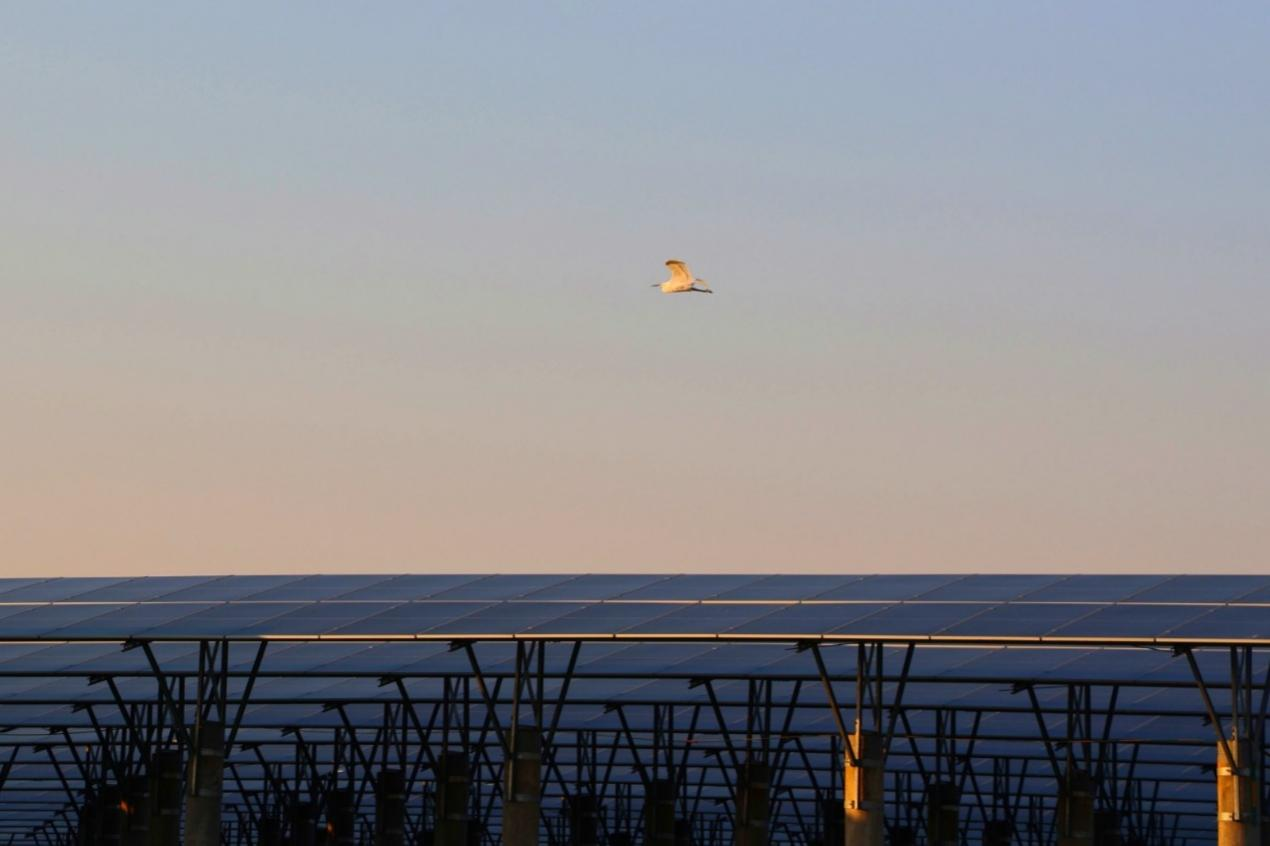
At dawn over the Yellow Sea mudflats, 700,000 deep-blue panels stand like a silent fleet facing the wind. This is the 400-megawatt Sea-Solar power station newly built by CHN Energy in the Rudong reclamation area in east China’s Jiangsu province.
A year ago, the site was overrun by invasive cordgrass, with compacted soil and scarcely a trace of birds. Today, the grass has been cleared, channels reopened, and panels raised. The sun now delivers 460 million kilowatt-hours of green electricity each year. Beneath the panels, tidal creeks flow again, egrets return, and fish and shrimp move with the tides, turning a barren flat into a living ecological corridor.
Along the same latitude to the west, a 147-megawatt Fish-Solar project in Taizhou has covered 2,900 mu (around 1.93 million square meters) of fish ponds with a blue roof. The panels cast shade that cools the water and reduces evaporation. Ducks and geese roam between the arrays, while crabs and shrimp shelter at the bases of the pillars. Fish farmer Mr. Chen has divided his 50 mu (around 33,333 square meters) of ponds into four seasonal harvests: before the Spring Festival, photovoltaic-raised geese sell for 100 yuan (around 14.35 USD) each; in golden autumn, 15,000 kilograms of fish and shrimp are netted, pushing his annual income steadily beyond 200,000 yuan (around 28,717 USD). The power station also gives priority to nearby villagers for temporary jobs such as debris removal, cleaning and logistics. For Mr. Wang, his cooking ladle and fishing nets turn together, earning him over 10,000 yuan (around 1,436 USD) each year.

Farther southwest, in the Longquan tea plantation of Dongzhi County, east China’s Anhui province, a 50-megawatt Tea-Solar power station follows the rolling hills. The supports rise 3.5 meters high with eight meters between rows, filtering sunlight into a gentle glow. Without harsh winter exposure or scorching summer heat, the tea leaves grow more tender. Tea farmers lease their land to the station for 2,000 yuan (around 287 USD) per mu each year, then return during harvest season for day work at 200 yuan (around 28.7 USD). By year’s end, rent plus dividends add more than 20,000 yuan (around 2,871 USD) per household. Peas are intercropped between the tea rows as green manure, reducing pesticide use and helping spring tea command a higher price.

From mudflats to fish ponds to tea gardens, CHN Energy turns photovoltaic panels into a precise measure of light. The same sunlight, in different settings, is converted into electricity, harvests, rent and wages, flowing directly into villagers’ accounts. There are no slogans, only balance sheets—sunshine translated into countable fish and shrimp, measured yields and real income, rooted in the soil and seawater of the Jiangnan region.

