

With Cangshan Mountain and Erhai Lake in the distance and layers of verdant hills stretching across the horizon, southwest China’s Yunnan province remains lush and springlike even in winter.
In Cangyuan County, at the Mengsheng Farm photovoltaic power station operated by CHN Energy’s Guohua Energy Investment Yunnan Branch, scenes of daily labor blend seamlessly with the beauty of rolling tea plantations.
At 7 a.m., Wa ethnic youth Yan Cong joins other villagers in the tea gardens beneath the solar panels to begin the day’s work. “In the past, farming depended entirely on the weather. Now I work in the PV tea garden and earn 3,500 yuan (around 500 U.S. dollars) a month. It’s much more stable than before, and I plan to introduce my relatives to work here as well,” he said with a shy smile.
Yan Cong recalled that villagers once relied mainly on industrial sugarcane and tea farming, living in earthen houses and traveling on muddy dirt roads during the rainy season. In recent years, with the advancement of agrivoltaic projects, photovoltaic panels have spread across the tea-covered hills, and new development concepts have taken root in people’s minds. This former Wa ethnic settlement has begun a steady transformation.
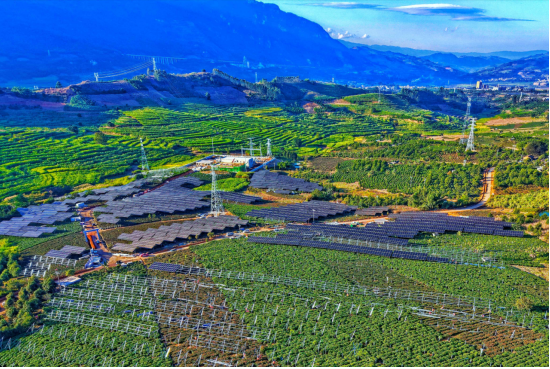
Guohua Energy Investment Yunnan Mengsheng Farm Project
How can a beautiful mountainous area balance development with protection? For Cangyuan County, the answer lies in tea, achieving both ecological conservation and prosperity.
The Wa ethnic group is among the earliest tea cultivators in China, and local elders say, “Wherever there is a Wa village, there are tea trees.” The tea industry directly affects the income of about 60 percent of farmers in the county.
“The main variety grown in the PV tea garden is large-leaf tea,” explained He Dong, head of production preparation. “It has dark green leaves, a pure and lasting aroma, a rich and mellow taste with lingering sweetness, a clear greenish-yellow liquor, and thick yellow-green leaves. Fresh leaves are rich in tea polyphenols, with catechins accounting for about 70 percent, making them especially suitable for black tea and Pu’er tea.” During cultivation, the shading effect of the solar panels effectively suppresses weed growth. Estimates show weed biomass has been reduced by about 60 percent, herbicide applications have dropped from four times a year to once, soil organic matter has increased, and overall tea quality has improved.
A good model brings tangible benefits. “When we relied only on primary farming, net income was just about 2,000 yuan per mu (around 4,167 U.S. dolalrs per hectare),” said village Head Wei Guangming. “Now the project provides 400 to 500 jobs related to PV tea cultivation, along with long-term land lease income. Average per capita income has exceeded 5,000 yuan (around 713 U.S. dollars).” Villagers can also attend skills training offered by the project team to learn photovoltaic equipment maintenance and scientific tea garden management, enabling sustainable income growth. “I used to think high technology was far beyond us. Now I see that as long as we are willing to learn, we can master it too,” Yan Cong said while practicing solar panel cleaning techniques.
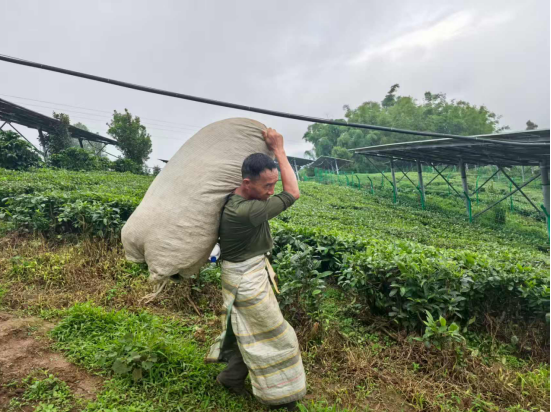
Villagers working in the tea plantation
In the Awa Mountains, vast tea forests stretch beneath misty clouds.
Developing tea–PV complementarity here was not without challenges. At elevations of 950 to 1,150 meters, how could limited space accommodate both traditional tea cultivation and clean energy development? The PV+ model provided the solution. With eco-friendly compatibility and precise design, the solar panels not only avoided hindering tea growth but even increased yields by about 10 percent.
“To resolve the tension between land use and protection, our project team crossed mountains and valleys to innovate a staggered PV array layout,” said Niu Yuan, the project manager. “By raising the mounting structures to 2.5 meters, we ensured sufficient space for farmers to work while using diffused light beneath the panels to optimize the tea-growing environment.” This model of power generation above and tea cultivation below delivers both ecological and economic benefits.
“These panels are like umbrellas for the tea trees, providing shade in summer and frost protection in winter. The tea grows better,” said tea farmer Uncle Li, pointing to the thriving plants beneath the panels. Since full operation, the project has generated about 370 million kilowatt-hours of electricity annually, enough to meet the county’s electricity demand for three years, and reduces carbon dioxide emissions by approximately 305,000 tons each year.
The tranquil mountains and verdant tea trees embody the simple truth that lucid waters and lush mountains are invaluable assets.
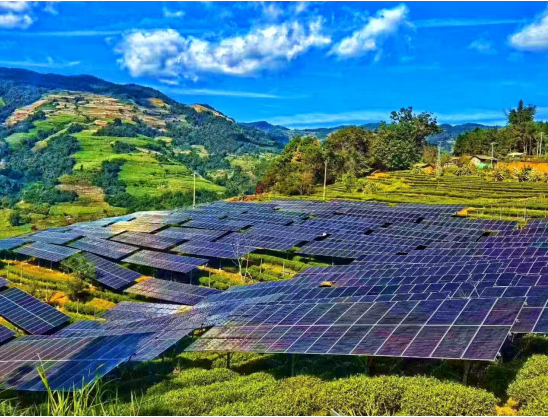
Guohua Energy Investment Mengsheng Farm Photovoltaic Power Station
In recent years, ecological development has become a new pathway for Yunnan’s green growth. Of the province’s more than 600 A-level and above scenic areas, 72 percent are eco-tourism destinations. By the end of November this year, Yunnan’s installed capacity of new energy exceeded 70 million kilowatts, marking a new milestone in green energy development and laying a solid foundation for building a national clean energy base. In Cangyuan, the Mengsheng Farm PV power station is not only a clean energy facility but also a livelihood project integrating energy, agriculture and culture. Respecting the Wa ethnic group’s traditional tea-picking practices, the construction team widened the spacing between PV arrays to 4.4 meters, making the design more suitable for harvesting and enabling harmonious coexistence between modern technology and ethnic traditions.
Through sustained and coordinated efforts—from living and working alongside tea farmers to gaining a precise understanding of tea tree growth, from technological innovation to overcome mountainous terrain constraints to skills training for long-term empowerment—Guohua Energy Investment’s exploration in the Awa Mountain region offers a replicable model for similar areas and vividly illustrates Yunnan’s green development transition.
During the 14th Five-Year Plan period (2021-2025), Guohua Energy Investment has advanced 465,800 kilowatts of new energy projects in Yunnan. Looking ahead to the 15th Five-Year Plan period (2026-2030), installed capacity is expected to reach 1.5 million kilowatts. “We will fulfill the social responsibility of a central SOE, using the Mengsheng Farm PV project as a model to promote green and low-carbon development and support comprehensive rural transformation,” said Pei Miao, Deputy General Manager of Guohua Energy Investment Yunnan Branch.
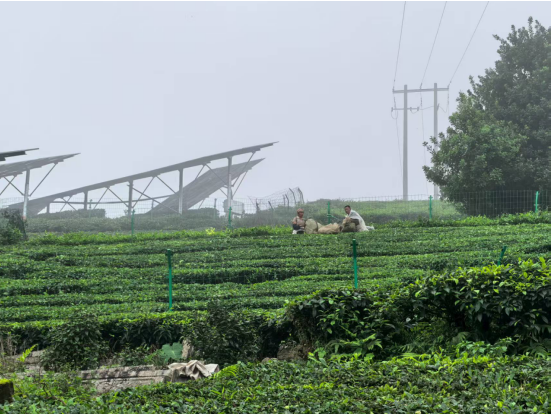
Photo: Villagers harvesting tea leaves
As dusk falls over the Awa Mountains, rows of solar panels shimmer alongside smiling faces, together painting a vivid picture of revitalization marked by thriving industries, a beautiful environment and prosperous communities. This land, named Colorful Yunnan during the Han Dynasty for its auspicious clouds, is now writing a new chapter of high-quality development, where tea and solar power shine together in a new era.

