

Hydrogen is a key pathway for future energy transition. From vision to reality, where does the global industry stand today? And what role is China playing? On March 25, CHN Energy’s reporter had an exclusive interview with Ivana Jemelkova, CEO of the Hydrogen Council to take her insights on the hydrogen sector.
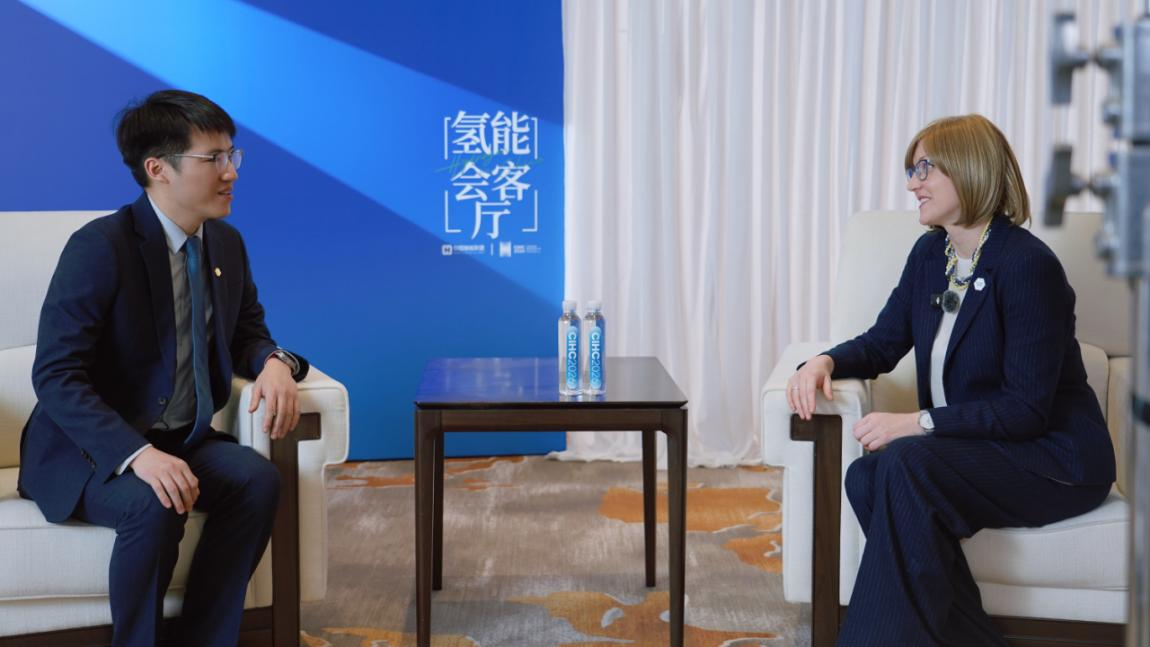
CHN Energy reporter having exclusive interview with Ivana Jemelkova.
Reporter: You’ve been CEO of Hydrogen Council for nearly two years. The industry has changed so fast. You helped shape the Hydrogen Council before it officially launched in 2017. Looking back, what was the biggest “unknown” back then—and what has surprised you most about how the industry has evolved?
Ivana: We’ve come a long way since the Hydrogen Council first came together at the World Economic Forum in Davos in January 2017. Back then it was 13 CEOs from across the energy, transport and industry spectrum who put forward, at the time, a bold idea, today we would say “no-brainer”. At the time a bold idea. And that is that hydrogen has a key role to play in the energy transition. Back then the focus was squarely on climate and decarbonization, but the conversation has of course evolved. Today we are really looking at hydrogen to build a cleaner but also more secure and more resilient and competitive future. We really see hydrogen as an opportunity for countries to maximize their domestic resources, the full spectrum, especially the renewable and cleaner side, an opportunity to open new trade partnerships, and provide the efficient, affordable, plentiful energy countries need to fuel their industries into a competitive future.
Reporter: When you officially took over as CEO in June 2024, you mentioned two priorities: unlocking clean hydrogen demand and building frameworks for global trade and investment. Where do you see the most tangible progress on those fronts today?
Ivana: The Hydrogen Council has come a long way since 2017. Today it brings together some 140 companies from 20 different countries and when I joined the Hydrogen Council as CEO some two years ago, we went through a whole rethink of how we want to show up for the industry and the role we want to play. You may know that the industry has really shifted from ambition, from vision setting into delivery, into execution. We at the Hydrogen Council track every single publicly announced project out there and measure the progress, and really, we’ve seen formidable progress, formidable forward movement. 110 billion dollars have now been committed to hydrogen projects. Over 510 projects around the world have reached financial closure, moved into construction or even operation, and that all represents a ten-x growth curve in five years. That’s really a formidable achievement for the industry and something that really positions as very comparably vis-a-vis solar, Wind, batteries and other clean energy technologies. But as you say yourself, the real work is ahead. The first ten-x is a fantastic achievement, but we need to keep going, we need to keep growing. And for that we need to unlock demand. Many good efforts in place. We need to firm up. We need to make sure that our policy is clear, practical, predictable and most importantly implemented. Follow-through is important and then, of course, infrastructure goes without question. Standards. Our ability to really measure, verify, certify and value the properties of our molecules, of our fuels, of our products. And finally, which is why I’m so happy to be here in China, it’s really collaboration. And I see enormous potential for the interplay between the Chinese hydrogen ecosystem and the global hydrogen community.
Reporter: Your “Hydrogen Insights” series is one of the most closely watched reports in the sector. The latest data show strong project pipelines, but also some delays in final investment decisions. What do you see as the critical factors to move projects from announcement to operation, especially in today’s economic climate?
Ivana: Thank you so much for asking the question. We’ve been incredibly transparent about both the successes as well as the learnings from the scale up journey of hydrogen. And again, it tracks with any other clean energy technology that goes through the same process: a lot of ideas, a funnel of announcements, a large pipeline of announcements, and then those ideas meet the reality checks of the commercial environment, and some of them move forward very successfully while some don’t. In solar, I believe the ratio was approximately one out of ten projects. We are roughly in the same area with hydrogen. We counted in the last 18 months some 50 projects were publicly announced to be canceled, obviously there’s probably more that have not been announced, but that is on a pipeline of 1700 projects of which 500 plus have now moved into FID construction or operation. So, it’s a normal phase of rationalization, normal phase of refocus, normal phase of commercial reality checks, and we’re really delighted to see that strong projects are making it, that strong projects are moving forward. In fact, the operational capacity for clean hydrogen production will double this year, again a formidable, formidable achievement by the sector.
Reporter: The Council has been vocal about the need for harmonized standards and certification. Given the different approaches in the EU, US, and Asia, do you think we are moving toward a globally recognized certification system, or will we see multiple regional systems co-existing?
Ivana: Global standardization is an imperative for hydrogen success. Hydrogen works at its best and delivers the best benefits when it moves globally. So, what we really need is a unified global language for hydrogen standards. At the Hydrogen Council, we’ve been working very closely with a number of international bodies that specialize in standardization. ISO is a key partner to the Hydrogen Council, and we have been actively involved in the development of ISO standards for carbon accounting, for life cycle carbon footprint of hydrogen, but also on the more technical front safety, connectivity and so on. So, we really strongly believe there needs to be one common language, and with that also one common playing fields, a level playing fields for all the players and all the companies from all around the world, so that both sellers and buyers can really orient themselves in the market, and choose the right products for their needs.
Reporter: CHN Energy has been part of the Hydrogen Council since the early years. From your perspective, how has China’s role in the global hydrogen landscape shifted over the past five years? What unique strengths do Chinese players bring to the Council?
Ivana: We are very happy to have CHN Energy as the steering member. The facts are extremely clear: China is leading the game when it comes to clean hydrogen deployment. Out of the $110 billion committed investment globally, China accounts for nearly 1/3 -- $33 billion as of 2025. And equally, China leads the game in terms of electrolizer deployment, renewable hydrogen production capacity and deployment, so it’s really fantastic to see and be here in China, see the speed and scale with which you have moved.
I think there are two key factors here: The number one factor is that China has chosen hydrogen as a strategic opportunity. That is critically important. It’s not nice to have. It is a strategic opportunity not only for decarbonization, but really for technology leadership, for industry competitiveness, and for energy security, national sovereignty, and I think that is so so key. The second one really is the pursuit of excellence and of highly competitive products. We see every day the strength of the Chinese players, and I’m very excited to see the collaboration between Chinese and international companies in this space, and I think we have a lot more opportunity.
Reporter: The Council has highlighted that Asia now accounts for over two-thirds of the world’s hydrogen refueling stations. What role do you see China playing in shaping the global hydrogen trade?
Ivana: When I look at the different geographies around the world, the differences are very clear. Asia is the hot spot, we have leaders such as China, but also Japan, Korea, India...very clear visions and strategies for hydrogen and also strong drivers whether it’s energy independence or the economic and social opportunity that comes with the deployment of hydrogen. I look further around the world and I see the likes of North America, fantastic conditions to be really producing clean hydrogen at scale and deploying it in the economy, however, especially in the United States, things have become somewhat unclear. So we are waiting to see how the US choose to move forward. In Europe, in theory, the number one world demand center, the policies have been put in place, but implementation has been somewhat slow and patchy, so I really see a huge opportunity for Asia to be leading the charge. And this is why I’m here right now. I’m spending time in Japan, in Korea, in China. We will be soon back in India. It’s really really formidable to see. So I see a huge opportunity ahead for these geographies, and being here and witnessing the conversation about the next Chinese five-year plan is really impressive, because again the the choice of the strategic importance of hydrogen continues, but it goes even further. There was thought about indeed spreading the deployment further out, not only in the vehicle deployment use or in the vehicle, deployment segment, but also across the economy and also that relentless drive to lower cost while increasing the volume. Is is very impressive, so I think there are some really exciting opportunities on the horizon.
Reporter: Before we wrap up, is there anything you’d like to add -- perhaps a message to the broader hydrogen community in China?
Ivana: As I mentioned at the beginning, the sector has really moved from ambition to delivery, and that building, that forward movement is really key. So it feels especially symbolic to be here in China in the year of the horse. That, to me, symbolizes the forward movement, the hard work that we put in, but also the energy and the stamina that we bring into the game. So my message is very very simple: please keep working, please keep building, keep moving hydrogen forward together in collaboration between Chinese and and international players. Keep moving. Keep building. Keep moving forward.

