

The first to sense the arrival of spring are not the blossoms along the banks, but the fish in the Dadu River. As the warm currents of March quietly seep into the riverbed, species such as the schizothorax davidi, leptobonia elongata, schizothorax prenanti and beaufortialiui—many of them nationally and provincially protected, along with rare endemic fish from the upper Yangtze—begin to gather and set out, guided by memories etched in their genes, swimming upstream toward their spawning grounds.
Along the route of their migration stands a 1.22-kilometer-long fish passage at the Zhentouba I Hydropower Station of CHN Energy Dadu River Branch. Resting quietly on the left bank, the channel waits beside the river. A single gate separates the surging waters while also reconnecting the long-awaited path home for fish that have waited through the winter.
At 8:30 a.m. on March 1, the shift-handover meeting began on schedule at the Production Emergency Command Center of Zhentouba Company. The incoming and outgoing operators stood face to face in two lines, their notebooks filled with dense records of the previous shift’s operating data. After the handover, deputy shift supervisor Cheng Jiawei gave a special reminder: “Today is March 1. After the day shift takes over, prepare the operation tickets for putting the fish passage into service.”
As soon as the shift change ended, the operators picked up the operation tickets and walked briskly to the gate hoist room at the upstream outlet of the fish passage. “Check that the power supply to the fish passage outlet gate motor is properly connected.” “Switch the gate control handle to automatic mode.” One command after another was carried out in an orderly manner as the fish passage system officially started operation. On the monitoring screen, the gate opening values kept changing: 10 percent, 20 percent, 50 percent, 100 percent.
The gate linking the river with the journey home opened fully on time.
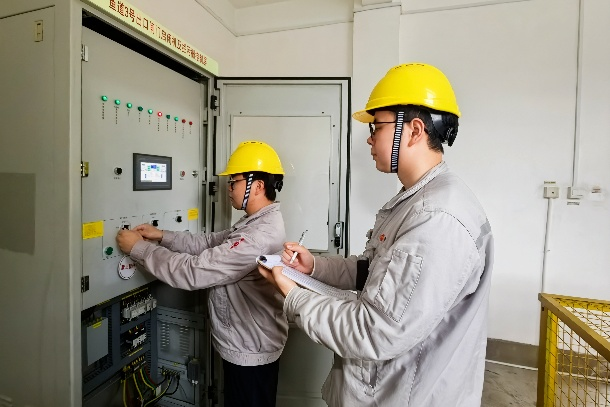
Operators putting the fish passage into service
Just a hundred meters away on the left bank of the Dadu River, a gentle stream of water was diverted into the fish passage. It flowed upward along a zigzag channel, passing through vertical-slot partitions that dissipated and buffered the current before finally merging quietly with the upstream river. In that moment, the surging waters of the Dadu River and the migratory path the fish had awaited all winter were truly reconnected. No one could predict exactly when the fish would arrive, but everyone at the power station knew that somewhere in a deep pool of the river, fish were already setting off, swimming toward this life channel. They might never know why the gate had opened, but the guardians on the shore understood.
This 1.22-kilometer passage is far more than a simple waterway. The Zhentouba I Hydropower Station is located in Jinkouhe District of Leshan, Sichuan Province, on the main stream of the Dadu River, an important habitat for many rare fish species. Some of these fish are listed in the China Red Data Book of Endangered Animals, while others are unique to the upper Yangtze River. Their survival and reproduction are directly tied to the ecological balance of the entire watershed.
The construction of a hydropower station inevitably alters the natural continuity of a river. For migratory fish that must swim upstream to reproduce, dams were once formidable barriers. Finding a way for engineering projects to coexist with natural life became a question Zhentouba Company had to answer. Their solution was this migration channel designed specifically for fish.
It was far from an easy project. The Zhentouba I Hydropower Station has a head difference of 34 meters, equivalent to the height of more than ten floors. With such a drop, the force of the natural current is extremely strong and unsuitable for fish passage. As the first high-head ecological fish passage project of its kind in China, the technical team adopted a scientific design using vertical-slot partitions to gradually reduce the water’s force, keeping the flow velocity within a range that fish can safely navigate.
Thus the winding zigzag channel took shape. In each pool, the water circulates, slows and settles before entering the next section. Fish can move upward step by step, resting and regaining strength in every pool before continuing their journey. Each pool serves as a midway station; every meter of the passage forms part of the road leading back to their spawning grounds.Putting the fish passage into operation is not simply a matter of opening it. Ensuring that the channel functions effectively, scientifically and efficiently over the long term is the real test. Alongside the passage, an intelligent monitoring system integrating the Internet of Things, big data and artificial intelligence has been put into use. Underwater high-definition cameras, water-quality sensors and flow-velocity monitoring devices together form a tireless “ecological eye”, recording every detail in the fish passage around the clock.
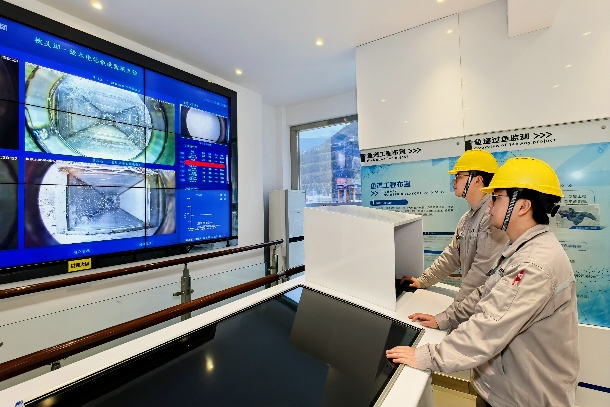
Operators checking the intelligent monitoring system
According to the operating plan, starting from March 1 each year, the fish-attraction devices are activated at fixed times every day, opening the life corridor for fish throughout the migration season. Meanwhile, the monitoring system continuously transmits real-time data: which species pass through, when they arrive, how many there are, and how long they remain—everything can be clearly tracked.
“In the past, we had to rely on manual observation. It was time-consuming and the data was not always accurate,” explained Wang Qian, an operation and maintenance technician working in front of the monitoring screens. “Now this system can precisely count the species and number of fish passing through, while also monitoring water quality and flow velocity in real time. It provides reliable scientific evidence for us to adjust operational methods.” The continuously accumulated data not only confirms the ecological value of the fish passage but also offers important support for ecological protection across the entire Dadu River basin.
While the fish passage quietly awaits the return of migrating fish, inside the nearby powerhouse the giant turbine generators run steadily, transforming the rushing river water into clean electricity delivered to countless homes. On one side is the steady pulse of modern energy production; on the other is the gentle call of natural life. At Zhentouba, these two paths meet in harmony through the dedication of its people.
“When we see the equipment running smoothly and the data coming back steadily, knowing the fish passage is working, that sense of reassurance is no less satisfying than generating a few more kilowatt-hours,” said shift operator Lü Yang.
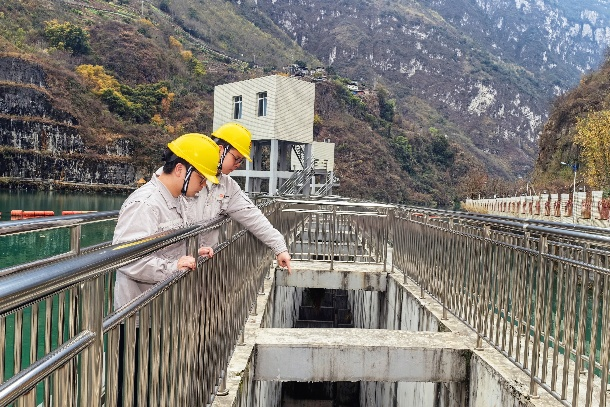
Operators inspecting the fish passage on site to check if it is operating normally
Spring waters have warmed, and the fish are returning. Along the banks of the Dadu River, the builders from CHN Energy guard the lights of thousands of homes with one hand and protect the return journey of living creatures with the other. Every fish that completes its migration becomes the warmest story of spring—and, in their hearts, the gentlest moment of power generation.

