

March arrives, and spring once again paints the land green.
At CHN Energy’s coal mines, technicians fix their eyes on screens of constantly shifting data. An integrated sky–air–ground–underground monitoring system is tracking every trace of methane in real time. Not far away, the zero-carbon heating system at Liuta Coal Mine operates quietly. Behind its annual reduction of 5,413 tons of carbon emissions lies a subtle transformation in how coal is extracted.

New pathways for a traditional industry
As the world’s largest coal producer and supplier, CHN Energy faces a direct challenge: how to ensure energy supply while making this traditional industry cleaner.
At the Huangbaici Coal Mine of Wuhai Energy, the Group’s first project for utilizing ultra-low-concentration gas through regenerative oxidation converts methane with concentrations below 8% into heat energy, reducing pure methane emissions by 5.2 million Nm³ annually. What was once vented directly into the air is now captured and reused. In the Zhunneng mining area, comprehensive energy consumption per ton of coal stands at 3.35 kilograms of standard coal, outperforming national advanced benchmarks. The country’s first 110-ton hydrogen-powered mining truck has been put into operation here, cutting more than 1,000 tons of carbon emissions per vehicle each year. At the Baorixile open-pit mine, China’s first microalgae carbon sequestration system for mining areas has made carbon capture plus ecological restoration a reality, as microalgae absorb carbon dioxide and gradually restore vegetation on waste dumps.
By the end of 2025, 80% of the Group’s mines at or above the provincial level had been designated as green mines. Behind this figure lies continuous technological upgrading and ecological restoration at every site.
The transformation of coal-fired power is also underway. Carbon capture projects at the Jinzhou and Taizhou power plants have been operating for years, while a 4-million-ton CCUS demonstration project has entered the construction phase. Four generating units have been selected for China’s new-generation coal power pilot program, exploring more flexible regulation capabilities.
In the coal chemical sector, coal is shifting from fuel to material. CHN Energy Ningxia Coal Industry has established a full industrial chain from coal-to-olefins to coal-based new materials and coal-to-liquids. From a barrel of oil to a grain of rice and a strand of fiber, coal can now be turned into biodegradable materials and fiber products. The world’s first 600,000-ton-per-year coal-to-polyglycolic acid biodegradable materials project at Yulin Chemical is operating steadily. Aviation kerosene produced by the Ordos coal-to-liquids company supports rocket launches. At Baoqing Coal Power and Chemical, lignite rich in humic acid has been developed into soil conditioners, turning over 600 mu (0.4 million square meters) of waste dumps into farmland.
Scaling up clean energy
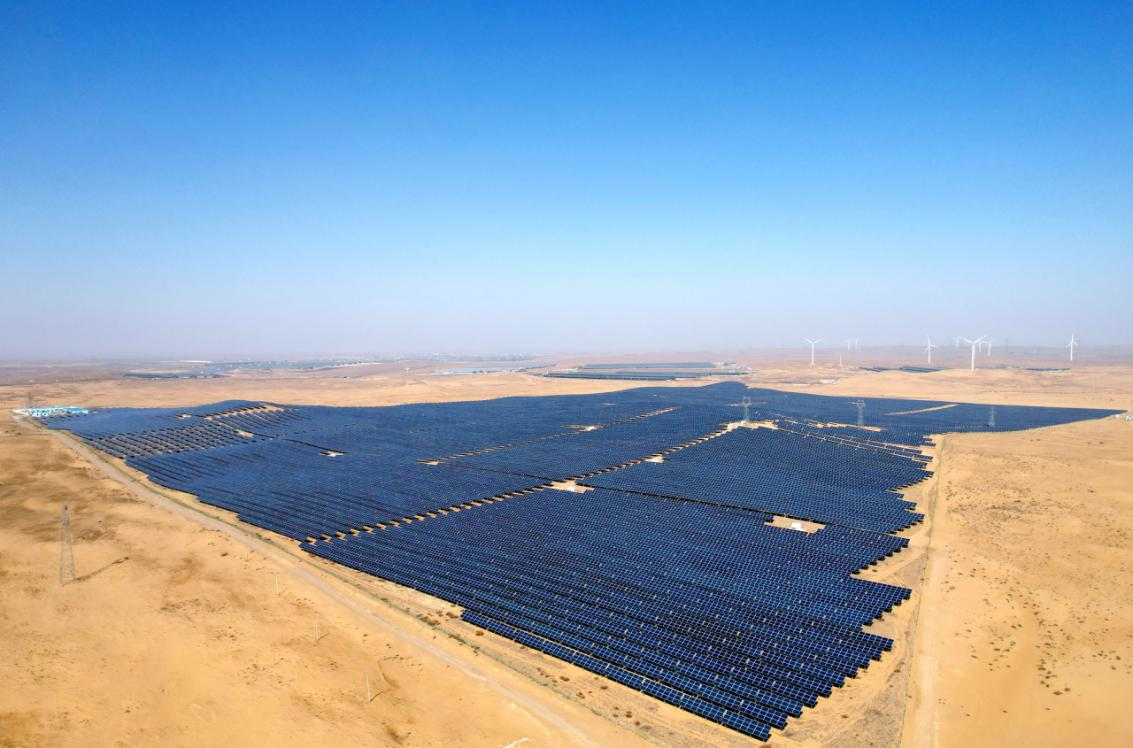
In Lingwu, Ningxia, a 4-million-kilowatt photovoltaic base built on a former coal mining subsidence area glows blue under the sun. Once scarred by mining, the land has become a green energy valley, supported by a 600 MW/1,200 MWh energy storage facility that stabilizes solar power output.
On the edge of the Tengger Desert, more than 6.4 million photovoltaic panels stretch across 80,000 mu (around 53 million square meters) of sandy terrain. Beneath them, plants such as sea buckthorn and alfalfa are taking root. The panels reduce wind and stabilize sand, while vegetation helps retain moisture, forming a virtuous cycle of power generation, ecological restoration and land improvement.
By the end of February 2026, CHN Energy’s installed renewable energy capacity had exceeded 160 million kilowatts. In desert areas, the Gobi, and other arid areas, the Group has completed and put into operation 10.9 million kilowatts of projects under the second batch of national large-scale renewable bases and 5.425 million kilowatts under the third batch. Offshore, the Kenli one-million-kilowatt project—the world’s largest open offshore photovoltaic project—set a record for the fastest construction among its kind. The offshore booster station for the Dongfang project in Hainan has been installed, the Lianyungang 1 GW offshore solar project is progressing steadily, and development rights for 2 million kilowatts of offshore wind power in western Hainan waters have been secured.
Hydropower development is also advancing. The Benzilan Hydropower Station has received approval and commenced construction, while the Danba project is exploring mixed-ownership investment. In the Dadu River basin, the Shaping I and Chuosijia hydropower stations have begun operation, and projects such as Shuangjiangkou, Jinchuan and Zhentouba II are scheduled for centralized commissioning within the year. By the end of February 2026, the Group’s hydropower capacity under construction had exceeded 15 million kilowatts.
Efforts to expand hydrogen and energy storage are also steadily advancing. The seven stations and three plants have been completed and put into operation, with green hydrogen production capacity reaching 6,000 tons per year, accounting for 5% of the national total. The Suzhou 1,000 MWh molten salt thermal storage project—the largest coal-power-plus-molten-salt storage project in China—has been put into operation, addressing the long-standing challenge of decoupling heat and power generation. A total of 195 new-type energy storage projects have been commissioned, with an installed capacity of 7.81 million kilowatts / 18.77 million kilowatt-hours. Eleven virtual power plants have also been put into operation, aggregating 2.81 million kilowatts of flexible resources.
Living in harmony with nature
On March 1, the fish passage at the Zhentouba I Hydropower Station on the Dadu River opened on schedule. Underwater cameras captured schools of schizothorax davidi swimming upstream step by step along the 1.22-kilometer zigzag channel toward their spawning grounds.
This is a routine scene in CHN Energy’s ecological protection efforts.
At mining sites, ecological restoration continues. Zhunneng Group planted 208 mu (0.14 million square meters) of trees over the year and advanced integrated environmental management across mines and surrounding areas within a 10-kilometer radius. Shendong Coal has carried out systematic restoration across more than 800 square kilometers of subsidence areas. All 13 mines and 14 shafts under its management have been designated as provincial-level green mines. A total of 371 ecological restoration projects have been implemented, creating 16,020 mu (around 11 million square meters) of ecological forest.
In desert regions, vegetation is steadily expanding. At the Tengger renewable energy base, photovoltaic panels help stabilize sand while economic crops are cultivated beneath them. In Yutian County, deep in the Taklamakan Desert, local teams have installed drip irrigation systems and planted 18,000 mu (12 million square meters) of sand-fixing vegetation, effectively curbing the spread of shifting dunes. A new team from Longyuan Power’s design institute has entered the Badain Jaran Desert to conduct micro-siting surveys for wind turbines, enabling coordinated progress in renewable energy development and desert ecological restoration.
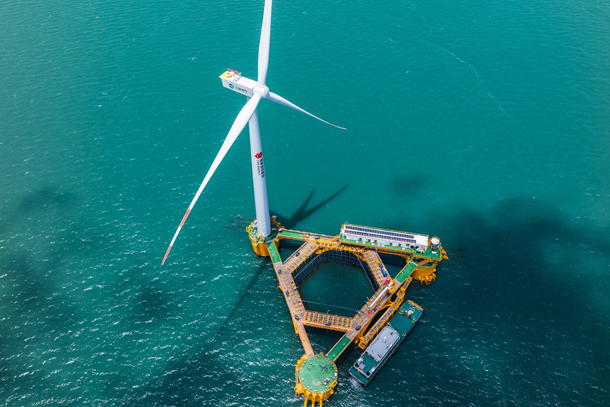
Across rivers, lakes and seas, biodiversity conservation continues. In the Yangtze River basin, the cascade hydropower stations on the Dadu River have, for the first time, achieved joint ecological dispatch across four stations. By simulating natural hydrological processes, they support fish reproduction and reopen a 200-kilometer migration corridor downstream. In the Yellow River basin, the Maerdang Hydropower Station has released 271,000 fish fry of schizopygopsis pylzovi, using fluorescent marking technology to monitor population recovery. Offshore wind projects in Zhoushan have completed ecological compensation within the national largehead hairtail conservation zone in the East China Sea, releasing 2.95 million fertilized cuttlefish eggs and 39,282 marked large yellow croaker. The world’s first floating integrated wind-power-and-fishery project, Guoneng Sharing, is operating steadily, generating electricity above the sea while farming fish below.
With green as its brush, this vast canvas continues to unfold across an ever-wider landscape.

