

The independently developed NICE Energy Supply Unit by the National Institute of Clean-and-Low-Carbon Energy (NICE) under CHN Energy has recently been put into operation in a rural livelihood improvement project in Gangca County, Haibei Tibetan Autonomous Prefecture, Qinghai Province. Operating at an altitude of 3,300 meters, the unit has achieved over 1,000 hours of continuous and stable off-grid performance, providing technical support for infrastructure upgrades in high-altitude and extremely cold regions.
For a long time, constrained by harsh geographical and climatic conditions, rural areas in Gangca County have faced technical bottlenecks in winter heating and energy supply during the transition from traditional dry toilets to flush toilets. To address this, the NICE energy storage R&D team collaborated with officials dispatched to Qinghai under the Group’s rural revitalization program to carry out technical research. After five months of development, the project team completed the overall upgrade of dry toilets centered on the self-developed NICE Energy Supply Unit, effectively resolving the challenge of powering flush toilets under extreme cold conditions.
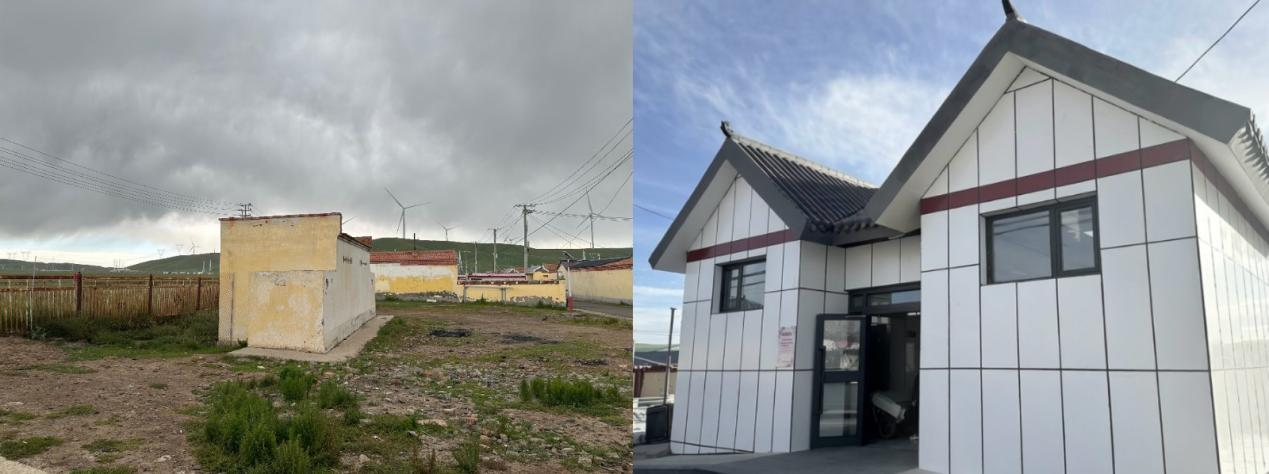
A comparison between traditional dry toilets and upgraded flush toilets in a village in Gangca County
It is understood that the NICE Energy Supply Unit integrates solid-state thermal storage modules with a multi-energy complementary microgrid system, featuring continuous heating, automatic on/off-grid switching and adaptive mode adjustment. It is suitable for distributed renewable energy generation and off-grid energy supply scenarios. During the extreme cold, strong winds and snow conditions over this year’s Spring Festival, the system maintained stable operation. Actual data shows that after deployment, the unit can reduce monthly electricity costs by approximately 90%, demonstrating the economic viability and feasibility of the technology.
In the next phase, NICE will continue to optimize system design and control strategies based on real-world operational data to further enhance overall economic efficiency and reliability. The R&D team plans to develop a replicable and scalable modular solution, promoting the application of the NICE Energy Supply Unit in more remote, high-altitude and cold regions, and providing solid technical support for rural infrastructure energy use and rural revitalization initiatives.

