

White wind turbines spin with the breeze in April on the Gobi Desert of Hami, Xinjiang Autonomous Region, converting invisible wind into clean electricity that travels thousands of miles to light up homes across the Central Plains.
Wind is free, but harnessing it takes skill.
At CHN Energy Guoshen Hami New Energy Company, a young enterprise established just three years ago, installed new energy capacity has reached 1.24 million kilowatts, with 167 wind turbines and 61 photovoltaic sub-arrays under management. In 2025, the company generated 1.603 billion kilowatt-hours of electricity.
Managing every turbine like a power unit
Ji Zhongwei spent half his career in thermal power before being appointed general manager of the new energy branch at the end of 2024. He had assumed wind turbine systems would be simpler and easier to manage, only to find that safety pressures had not diminished but increased: turbines are widely dispersed, with the farthest two more than 100 kilometers apart; high-altitude operations are frequent, and no link in the chain can afford mistakes.
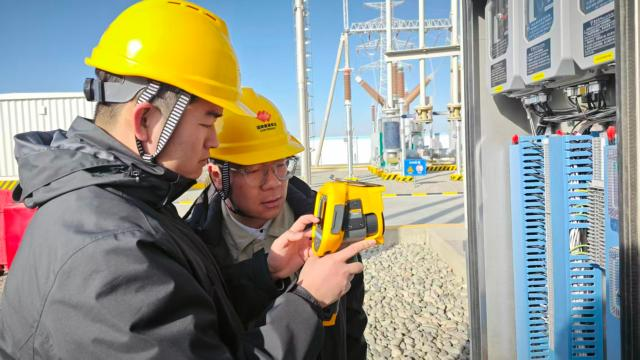
Young employees conducting equipment inspections
His solution was simple: “Treat every wind turbine like a thermal power unit.”
Drawing on experience from thermal plants, the branch established a strict defect management system: major defects must be resolved within a day, minor ones within a shift. Each turbine undergoes more than 160 maintenance checks, from the tower base to the nacelle. The torque of every bolt is reverified, and every sensor is recalibrated.
On March 13, the annual comprehensive inspection at Yushan Station was fully launched, lasting one and a half months. “This is the most exhausting time of the year, but also the most rewarding,” said operations and maintenance technician Xing Guibin.
The effort paid off. On January 17 this year, localized winds arrived in Hami, creating a golden window for power generation. Ji Zhongwei led all staff to remain on 24-hour standby, closely monitoring the operation of every turbine. Not a single unit faltered. On January 17 and 18, daily generation records were broken for two consecutive days, with a peak of 18.015 million kilowatt-hours in a single day.
Growing with the wind turbines
Growing alongside the turbines are 69 employees, including 21 experienced workers transferred from thermal power and 48 recent graduates who joined over the past three years. The average age is just 28.
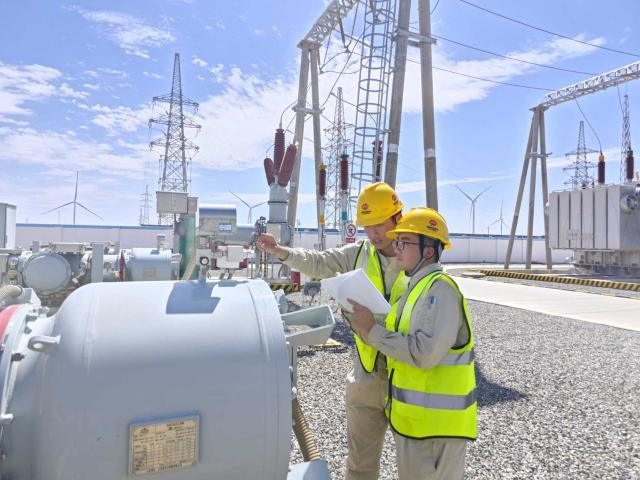
Young employees carrying out equipment monitoring and control
Zhang Guanghui, deputy station manager of Yushan, is one of them. After graduating in 2010, he worked at a thermal power plant for over a decade and once felt his career had reached a ceiling. When the new energy branch was established and the Jingxiaxi project faced a shortage of technical staff, he volunteered to help.
“At that time, it was lower than minus 20 degrees Celsius. The control room walls let the wind through, there were no windows, and electricity was temporarily drawn from a nearby town, with frequent outages,” Zhang recalled. “I wore up to six layers of clothing. When power cuts woke me up freezing in the middle of the night, I would get up and run indoors to keep warm.”
That experience helped him stand out in subsequent job competitions, allowing him to start anew in an entirely different field.
The 2023 cohort of new graduates joined construction work as soon as they arrived, laying cables, overseeing hoisting operations and assisting with inspections. Each was assigned responsibility for four turbines. Five or six people shared a single room, and meals delivered from more than ten kilometers away were often already cold. “They endured summers above 40 degrees and winters below minus 20. Not one backed down. All 18 stayed,” Zhang said.
From the first turbine’s grid connection to full-capacity integration, Yushan Station took only 27 days, setting a regional record in Xinjiang. In just two years, these young employees have grown rapidly—some becoming technical specialists, others moving into management roles, each capable of taking charge independently.
Making every moment count, with or without wind
In February this year, the company set a new target: 1.81 billion kilowatt-hours of annual generation, while accelerating the third phase of its new energy projects. Once completed, installed capacity will double again.
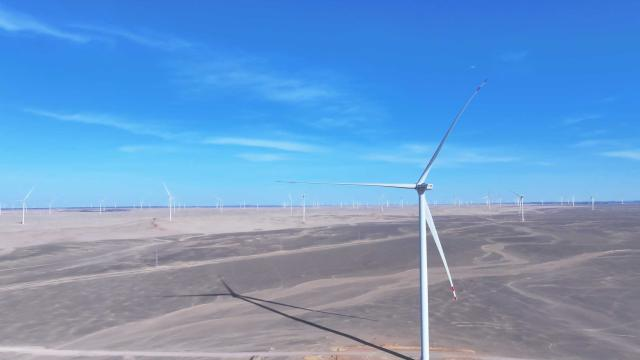
Site of the new energy wind power project
Even larger plans are underway. The company is preparing to build a Guoshen New Energy Training Base, leveraging its existing wind and photovoltaic resources and diverse turbine models to create an integrated platform for operations, maintenance and technical research, strengthening its talent pipeline for future development.
The development of smart stations is also progressing. Fifty-two independent systems will be integrated into a unified data platform. Drone inspections for photovoltaic facilities are already in use, inspection robots at booster stations are under testing, and drone inspections for wind turbines will be rolled out within the year.
From thermal power to wind power, from construction to operation, this team has honed its expertise on the Gobi Desert. When the wind comes, they are ready to capture it; when it does not, they never let time go to waste.

