

Driving south for more than two hours from downtown Yulin in Shaanxi leads to Wubu County. Here the Yellow River bends, and across the ravines of the Loess Plateau, rows of green pear orchards, stretches of photovoltaic panels and newly paved roads quietly record a story spanning over a decade between an enterprise and a county. Since 2013, CHN Energy has provided targeted assistance to Wubu County. To date, it has invested a total of 175.2 million yuan (about 24.3 million USD) in 172 projects, benefiting more than 40,000 people.
Rooting industries at the doorstep
Wubu County once lacked viable industries. Young people left to seek work elsewhere, leaving behind mostly the elderly and children. To retain people, there first had to be jobs.
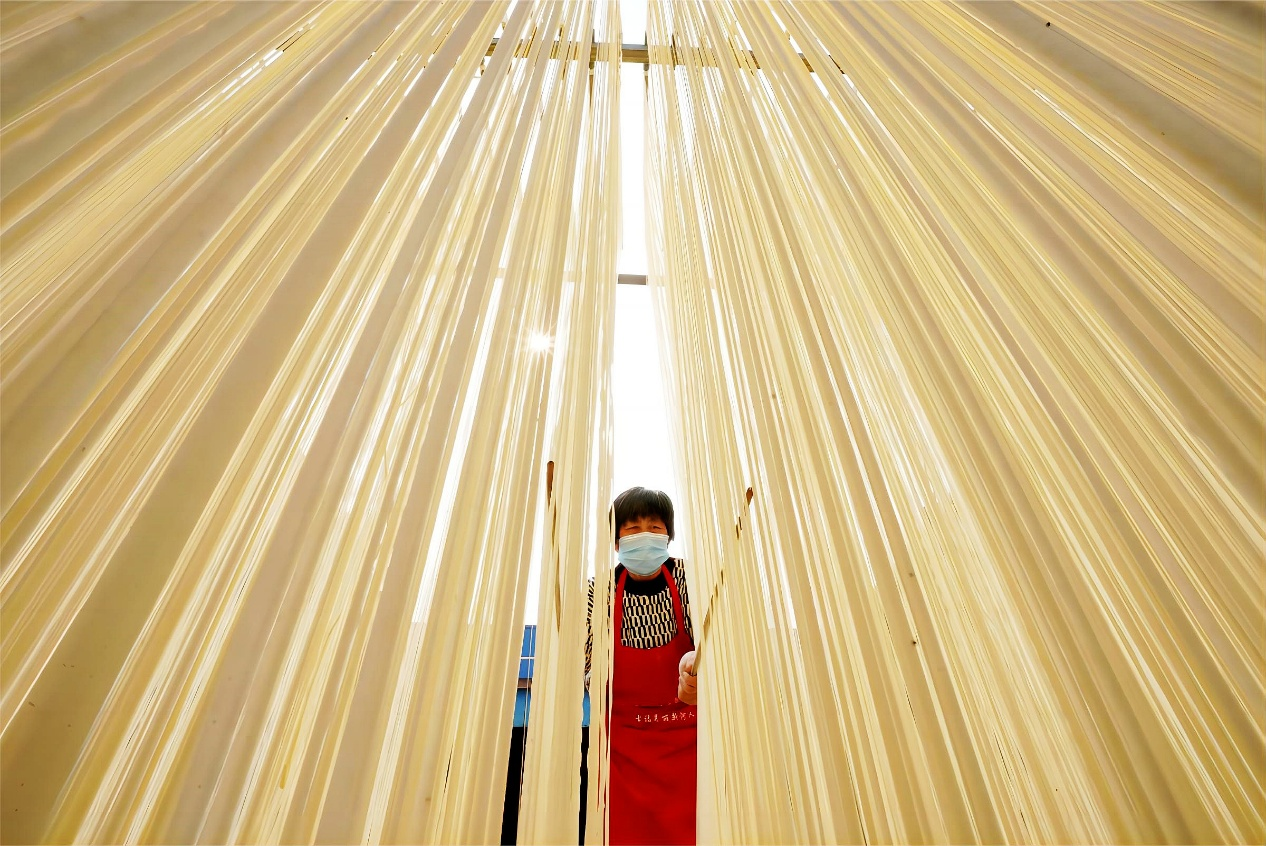
Workers at a handmade dried noodle factory in Wubu County are producing noodles
Handmade noodles are a traditional craft in Wubu, but for a long time they remained confined to household workshops. With an investment of 5 million yuan (about 0.69 million USD), CHN Energy helped transform noodle-making into a full-fledged industry through standardized production, unified packaging and expanded sales channels. Green pears offered another path. An investment of 13.84 million yuan (about 1.92 million USD) supported the transfer of 2,000 mu (about 133,333 square meters), along with hail protection nets, fencing and access roads. Five village collectives and 871 households have benefited, generating an annual income of 400,000 yuan (about 55,600 USD).
Zhang Qiming, head of the green pear base in Dalianpo Village, has witnessed the change firsthand: “I grew from an ordinary worker into a manager, earning around 60,000 yuan (about 8,300 USD) a year. Not only do I have a stable income, but I have also learned fruit tree cultivation and management techniques.” Cold storage projects have also been established in Xinjiagou, Chashang and Guojiagou towns. With an investment of 3 million yuan (about 417,000 USD), storage facilities have extended the shelf life of agricultural products, enabling fruit to be sold to more distant markets. “We aim not only to build industries locally, but also to help sell the products,” said Wan Zhiguo, deputy county mayor of Wubu County on temporary assignment from CHN Energy.
Keeping people and passing on skills
With industries in place, the next question was who would manage them.
Over the past decade, CHN Energy has partnered with local authorities to organize 30 training sessions, covering skills from electrical work and housekeeping to e-commerce operations. These programs have trained 2,803 skilled workers, 3,150 grassroots officials and 1,868 rural entrepreneurship leaders. In addition, employment has been secured for 40 college graduates from disadvantaged backgrounds.
Gu Yongqiang serves as the first Party secretary stationed in Chuankou Village. After his arrival in November 2023, he drafted a development plan for the village, promoting the implementation of four livelihood projects, including reinforcing industrial dams, renovating a cultural theater and building cold storage facilities. “Since Secretary Gu arrived, barren land has turned into fertile fields, roads have been improved, and cold storage has been built,” said Ren Yanrong, Party branch secretary of Chuankou Village.
Reliable water, better roads, steadier lives

The drinking water safety project in Mujiayuan Village, Koujiayuan Town, Wubu County
In Wubu, access to drinking water was once a major challenge for many villages. CHN Energy has invested a total of 58.89 million yuan (about 8.17 million USD) to build 40 water supply projects across 37 villages and groups, enabling more than 30,000 residents to access running water. Liu Wenjun, an elderly resident of Chejiayuan Village in Koujiayuan Town, turned on the tap in his kitchen, and clear water flowed out. “Being able to drink safe water straight from the tap at home is truly a meaningful improvement.”
Medical assistance has also continued. CHN Energy has invested 17.2475 million yuan (about 2.39 million USD) in healthcare support, ensuring that common and emergency illnesses can be effectively treated within the county. Facilities such as the health hut in Hongwan Village and the elderly care center in Lijiahe Village provide spaces for left-behind seniors.
Green growth on the Loess slopes
In Shenbianyan Village of Xinjiagou Town, a 630-meter photovoltaic corridor stretches along the village road. The deep-blue panels generate about 1.7 million kilowatt-hours of electricity annually, producing an income of 480,000 yuan (about 66,700 USD). After operating costs are deducted, the remaining revenue is distributed among 13 administrative villages in Xinjiagou Town.
Since 2020, CHN Energy has invested a total of 13 million yuan (about 1.81 million USD) in ecological support. Along the road by the Yellow River, 400 mu (about 26,667 square meters) of ecological forest have been established. In Xinjiagou Town, 590 mu (about 39,333 square meters) of forest have been planted with 66,100 Chinese pine trees and 108,660 apricot trees. Chuankou Village has been developed into a demonstration village integrating agriculture, culture and tourism, combining ecological restoration with rural revitalization. “These photovoltaic revenues help cultivate collective industries and promote economic exchanges, giving village economies a new engine,” said Huo Penghui, chairman of the joint cooperative of Xinjiagou Town.
More than a decade on, Wubu has undergone a quiet transformation. The young people working close to home, the elderly with access to clean water, the farmers cultivating green pears, and the trainees mastering new skills stand as the most direct witnesses to this cross-regional partnership.

