

In the early summer breeze, a renewed fishing village in Shangying Town, Lufeng, South China’s Guangdong Province, comes alive along the coast. Here, the Guangdong branch of CHN Energy Guohua Energy Investment has actively participated in the High-Quality Development Initiative for Counties, Towns and Villages through village-enterprise partnerships, directly benefiting 199 households and more than 700 local residents. The effort has created around 30 tourism-related jobs and generated approximately 3.3 million yuan (about 460,000 USD) in direct annual economic income for the area.
In the 2026 China Brand Evaluation rankings released in May, Guohua Energy Investment’s brand value rose to 24.781 billion yuan (about USD 3.45 billion). In 2025, the company invested 15.82 million yuan (about 2.2 million USD) in dedicated social responsibility programs, while related projects received 12 honors, including the Golden Key Excellent Solution award. From fishing villages in southern China to the shores of the Aegean Sea, a sweeping landscape of green energy development is steadily unfolding across mountains and seas.
Pursuing wind power across the sea while protecting ecology
The mountainous region of Thrace in Greece is rich in wind resources, yet wind power development there once faced ecological controversy because of overlaps with migratory bird routes. When Guohua Energy Investment entered the region in 2018, the team resolved to find a solution balancing industrial development and ecological protection for wind farms located near bird migration corridors.
The project team installed the DTBird anti-collision protection system on wind turbines. Acting as a highly sensitive smart eye, the system accurately detects approaching birds and issues warnings, maximizing protection for migratory species. At the same time, the company hired experts to conduct regular monitoring and provide detailed firsthand data to local environmental authorities, easing long-standing community concerns.
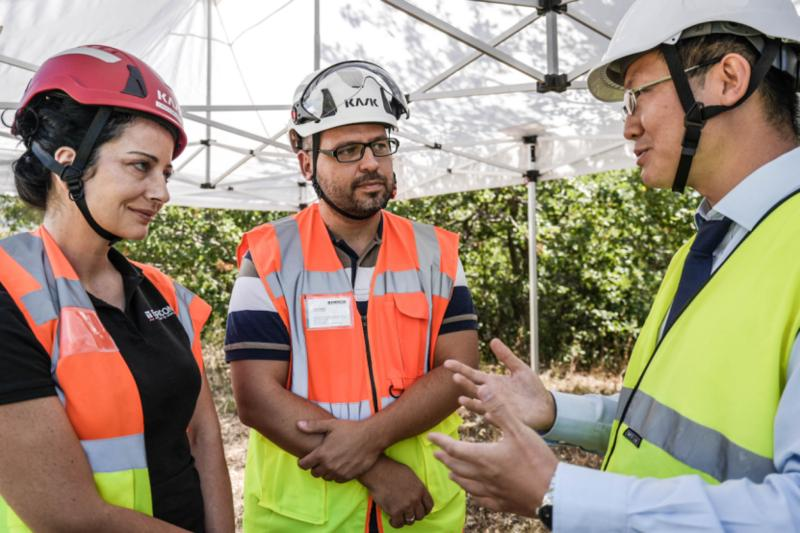
Chinese staff communicating with local residents in Greece
After ecological concerns were addressed, Guohua Energy Investment quickly established a model of shared economic benefits in the region. Through lean management practices, the team helped four local wind farms rapidly turn losses into profits and made a commitment to donate 2 percent of annual revenue to municipal development while allocating another 1 percent to subsidize local electricity prices. The project created more than 500 jobs during construction and employs over 50 local workers during operation. “My Chinese colleagues taught me step by step, and now I can independently handle most technical issues,” said local employee Georgios with pride. The governor of the Thrace region also remarked, “Guohua is not only an investor, but also our friend.”
Solar power revitalizes rural industries
On Hainan Island, where land resources are limited, integrated photovoltaic development tailored to local conditions has opened a new path for coordinated growth between clean energy and farming industries.
In Yueda Village of Dongfang City, photovoltaic supports were precisely set at a height of 2.5 meters to accommodate farm machinery operations, while panel tilt angles were fixed at 14 degrees to ensure sufficient scattered sunlight. The team selected shade-loving edible mushrooms as crops beneath the panels. Village official Fu Yongqiang was initially doubtful, but the solar panels soon became giant sunshades, lowering temperatures inside the sheds by 3 to 5 degrees Celsius compared with open-air conditions. The project area is now expected to produce 1,200 tons of mushrooms annually, with agricultural output value exceeding 8 million yuan (about 1.1 million USD).
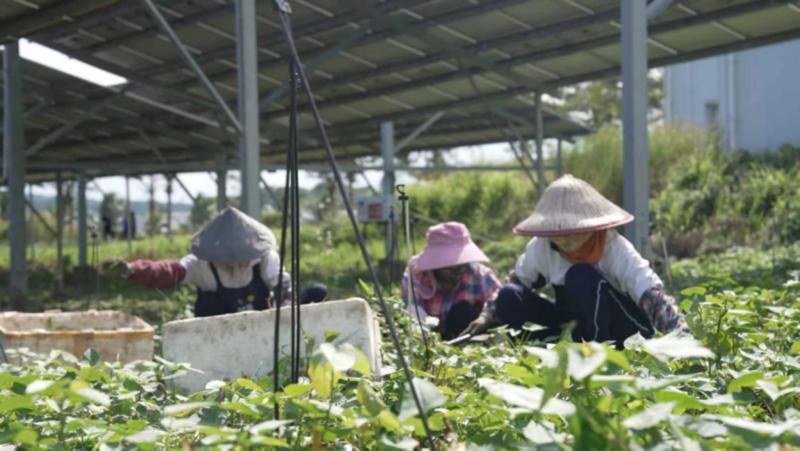
Villagers working in the agrivoltaic industrial park
More than 200 kilometers away in Wengtian Town, Wenchang, photovoltaic panels stretch across vast aquaculture waters. To withstand typhoons, the project adopted a flexible support system capable of resisting Category-17 typhoons. Fish farmer Chen Haiqiang calculated an unexpected benefit: the panels lowered water temperatures and reduced fish and shrimp diseases. “Last year, the net profit from my 50 mu (about 3.3 hectares) of ponds exceeded 200,000 yuan (about 28,000 USD). Together with water surface rental income, my earnings increased by 30 percent compared with before,” he said. Similar gains in added value and income have also been achieved through photovoltaic projects in tea plantations in Dongzhi, Anhui Province in eastern China, and fish ponds in Taizhou, Jiangsu Province on the east coast of China.
Restoring green landscapes through ecological rehabilitation
Wherever green energy projects take root, ecological restoration efforts follow. Beyond generating renewable electricity in wilderness and mountainous regions, Guohua Energy Investment has also taken on the responsibility of repairing damaged landscapes.
Large coastal mudflats in Rudong County, Jiangsu Province, were once overrun by the invasive species Spartina alterniflora. Led by project manager Jiang Bin, the team restored more than 4,300 mu (about 287 hectares) of coastal wetlands. After clearing the invasive plants, the site not only became home to a clean energy project generating 460 million kilowatt-hours of electricity annually, but also supported the rehabilitation of 5.4 kilometers of coastline. As wetlands recovered, the number of bird species in the area increased from 23 to 47, while the black-faced spoonbill, a nationally protected Class II species, returned to the bay.
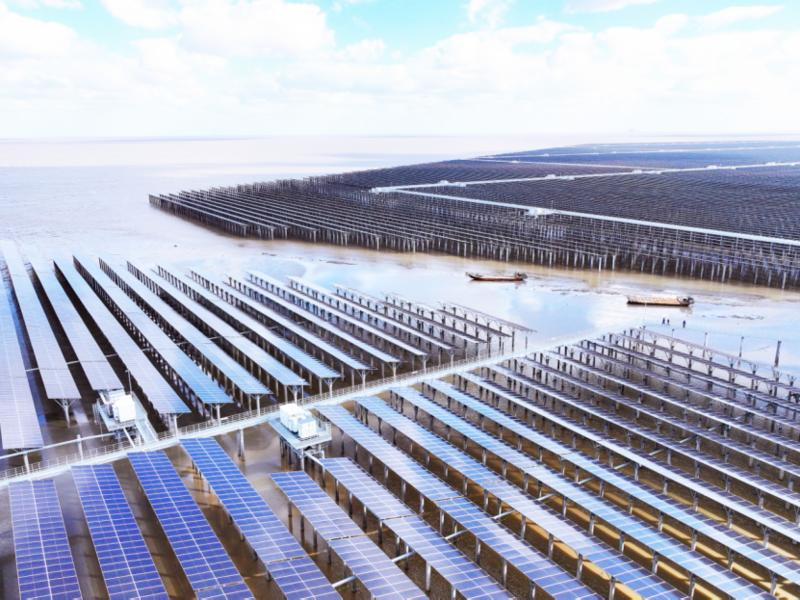
The restored tidal-flat photovoltaic project area after cleanup
In the karst regions of southwestern China, traditional revegetation efforts often fall into a cycle of “green in the first year, yellow in the second”. To address this challenge, Guohua Energy Investment launched the Integrating Greenery Into Construction initiative at wind farms including Dengyun Mountain in Guangxi Province in southern China and Chaijun Mountain in Hunan Province in south-central China. Construction teams adhered to the principle of prioritizing native species, selecting resilient plants such as Bermuda grass and shrub lespedeza while applying microbial restoration technologies. To date, more than 90,000 square meters of ecological revegetation have been completed, with overall soil erosion control exceeding 90 percent.
As winds sweep across mountains and seas, all things thrive together. From birds soaring over European mountains to villages along the South China Sea, and from wetlands on the eastern coast to the green revival of rocky landscapes in southwestern China, Guohua Energy Investment is transforming invisible wind and sunlight into tangible industrial value and ecological benefits. Rooted in soil and waves alike, these green energy projects are steadily reshaping local environments and improving the lives of surrounding communities.

