

Early summer sunlight spills across the rolling hills of Jishui County in east China's Jiangxi province, illuminating the slopes of Baizhuping in Badu Town. Stretching across the landscape, rows of blue photovoltaic panels follow the contours of the hills, while beneath them grow thriving rows of lush green medicinal plants known as Turpinia Montana (Shān Xiāng Yuán).
Just a few years ago, this vibrant and hopeful land was an abandoned hillside overgrown with weeds and left uncultivated. Today, thanks to the Jishui Badu agrivoltaic project led by Wan’an Power Plant under CHN Energy Jiangxi Branch, more than 1,000 mu (about 66.7 hectares) of idle land has truly become a source of prosperity for local residents.
Barren hills revived with new opportunities
In people’s memories, Baizhuping was once poor and infertile land. The soil layer was thin and lacking in nutrients. On rainy days, the paths turned muddy, while dry weather brought clouds of dust. Even after a full year of hard work, the returns were minimal, prompting many able-bodied villagers to leave for jobs elsewhere. As a result, over 1,000 mu (about 66.7 hectares) of land lay abandoned for years.
In the spring of 2023, the Wan’an Power Plant project team conducted its first site survey in Baizhuping. At that time, weeds stood waist-high, and even basic access was difficult. Initially, villagers were highly resistant to the visiting project staff, fearing that the land acquisition would threaten their livelihoods. Rather than rushing the project forward, the team organized visits for village representatives to mature agrivoltaic demonstration sites elsewhere in the province.
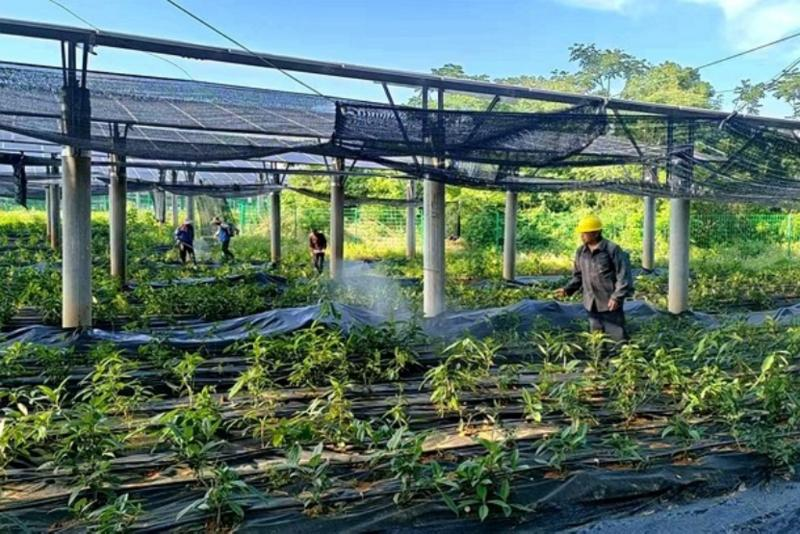
Farmers tend medicinal herbs beneath photovoltaic panels
Seeing was believing. When villagers witnessed that the elevated photovoltaic panels not only allowed farming to continue but also provided shade and moisture retention for shade-loving Turpinia Montana plants, all their concerns disappeared.
Once the doubts were resolved, progress moved smoothly ahead. At the start of construction, narrow and uneven rural paths were widened and paved. “In the past, transporting fertilizer meant carrying it on our backs. Now three-wheeled vehicles can drive directly to the fields,” said villager Liu Guiying with a smile. With the roads improved, the transfer of 1,500 mu (about 100 hectares) of land proceeded naturally.
Agriculture and solar power thrive together
Today, Baizhuping has been completely transformed.
Agrivoltaics is far more than simply installing photovoltaic panels above farmland. To ensure agricultural production continued smoothly, the project team designed the layout carefully around planting needs. The lowest point of the panels stands 2.6 meters above the ground, allowing adults to walk underneath without bending down. The spacing between panel rows was widened to 6.5 meters, enabling small farming machinery to move freely. Gaps were deliberately reserved between the panels so rainwater could seep evenly into the soil. Combined with shading nets, the design not only improves the efficiency of bifacial photovoltaic panels but also creates a mild growing environment for shade-loving crops.
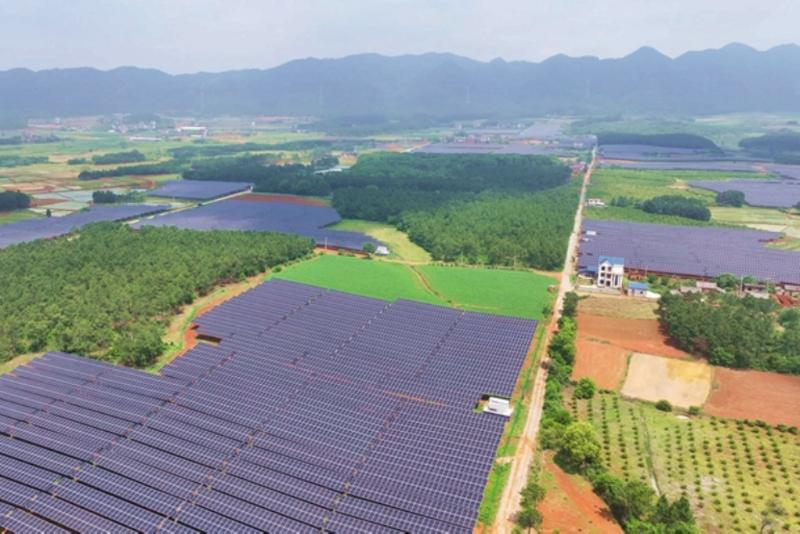
Jiangxi Jishui Badu agrivoltaic demonstration project
In December 2023, the first batch of photovoltaic modules was successfully connected to the grid. By August 2024, the project had reached full operational capacity. Each year, the project’s 174,000 photovoltaic panels generate 110 million kilowatt-hours of clean electricity, saving approximately 31,000 metric tons of standard coal and reducing carbon dioxide emissions by more than 80,000 metric tons. At the same time, Jishui County Liangshan Resources Holding Co., Ltd., together with Luxiling Forest Farm, jointly invested 10 million yuan (about 1.5 million USD) to establish a Turpinia Montana planting base and integrated irrigation and fertilization facilities. So far, 410 mu (about 27.3 hectares) have been planted. This authentic medicinal herb, which can be harvested continuously for more than 15 years after a single planting, has become a true “money tree”.
Green prosperity flourishes beneath solar panels
During every harvest season, laughter echoes beneath the blue panels.
Early in the morning, Aunt Zhang skillfully trims branches while filling bamboo baskets with thick green leaves. “This barren hillside used to struggle to grow even weeds. Now pharmaceutical companies are competing to buy these leaves, and we can barely transport them fast enough,” she said.
Under standardized management, mature Turpinia Montana fields can produce more than 300 kilograms of dried leaves per mu (about 4,500 kilograms per hectare). Based on current market prices, once the full 1,000-mu (about 66.7-hectare) scale is achieved, the project is expected to generate annual output value of around 9 million yuan (about 1.25 million USD). The base has already signed a 300,000-yuan (about 41,700 USD) order with Bai’an Pharmaceutical and established long-term partnerships with several daily chemical companies outside the province. Thanks to the plant’s natural anti-inflammatory properties, the market prospects for these green leaves are extremely promising.
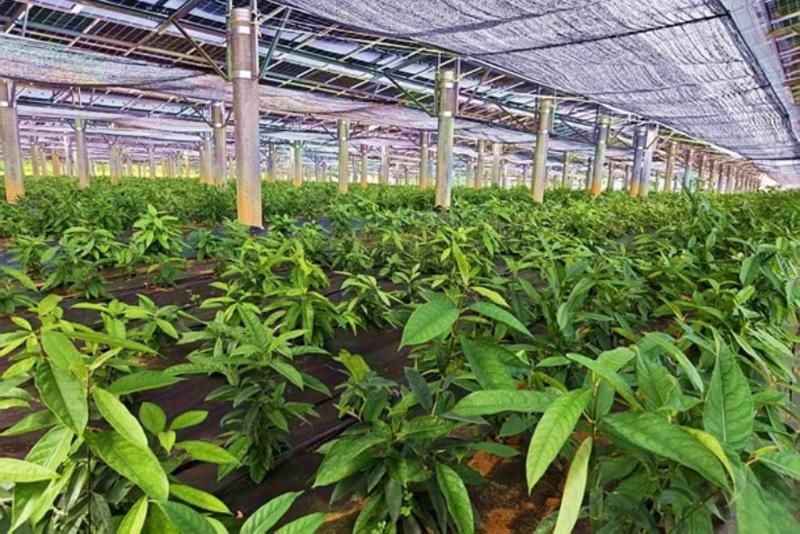
Turpinia Montana thriving beneath photovoltaic panels
For local villagers, the income calculation is now very clear: more than 200 yuan (about 28 USD) per mu (about 0.067 hectares) in annual land transfer fees, wages from working at the nearby base, and an additional fixed annual dividend of 240,000 yuan (about 33,400 USD) provided by the project to the village collective. These three stable income streams are expected to help 80 farming households increase their earnings steadily, with each household gaining an average annual income increase of around 5,000 yuan (about 700 USD).
Above the photovoltaic panels, sunlight is continuously transformed into green electricity. Beneath them, stretches of flourishing “golden leaves” carry the hopes of rural prosperity. From a neglected barren hillside to a thriving agrivoltaic industrial oasis, this cross-sector rural initiative has not only illuminated homes far away but has also firmly planted genuine prosperity into the soil of Baizhuping.

