

In the height of summer, the skies over Ordos, a city in Inner Mongolia Autonomous Region in northern China, are clear and blue. Deep within the vast mining area of Ejin Horo Banner stands a silver-white hydrogen refueling station, with neatly arranged pipelines and gleaming equipment. This is the Batuta Hydrogen Refueling Station operated by CHN Energy Guohua Energy Investment—the first hydrogen refueling station in China purpose-built for heavy-haul railways.
It officially entered commercial operation on June 2, 2024. Since then, this mining railway has been powered by a new source of clean and efficient hydrogen energy.
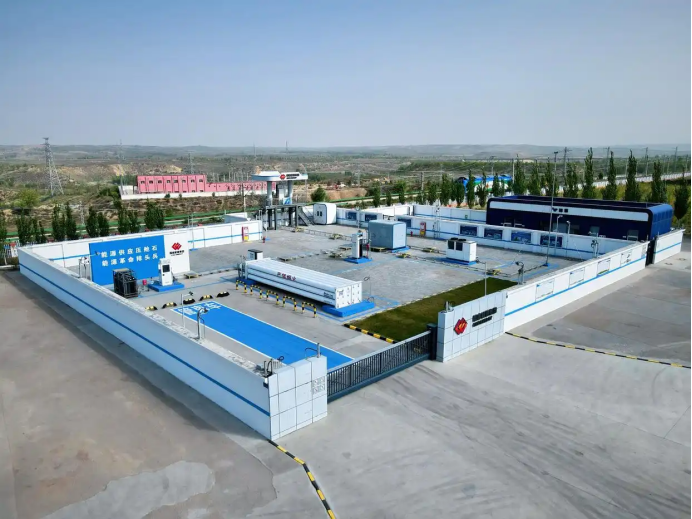
Batuta Hydrogen Refueling Station
Stepping into the operating area, visitors find hydrogen unloading facilities, compressors, hydrogen storage cylinders and dispensers arranged in perfect order. Surprisingly, there is none of the diesel odor or roaring machinery typically associated with conventional fueling stations. Instead, the site is clean, quiet and remarkably similar to a sophisticated laboratory.
Unlike conventional hydrogen refueling stations for road vehicles, this facility was custom-designed for heavy-haul railway locomotives. Equipped with a self-developed intelligent station control system, it completes the entire refueling process automatically through pressure differentials, requiring minimal manual intervention.
The station's most eye-catching feature is China's first high-flow hydrogen dispenser of its kind. Delivering hydrogen at up to 7.2 kilograms per minute, twice the flow rate of conventional equipment, it can fully refuel a hydrogen-powered locomotive in as little as 30 minutes. A full tank provides enough hydrogen for eight hours of continuous operation and enables an unloaded driving range of up to 800 kilometers.
Its strengths extend well beyond refueling speed. The project features a high-capacity, low-energy-consumption process control system for hydrogen refueling stations, combined with self-developed multi-load operating strategies that significantly improve compressor efficiency. In refueling accuracy, precooling energy consumption, performance under extreme environmental conditions, and intelligent operation and maintenance, the station outperforms comparable domestic and international products, achieving internationally leading standards.
Powered by this hydrogen refueling station, two domestically developed hydrogen-powered railway vehicles are now operating along the Batuta Railway. One is China's first high-power hydrogen-powered shunting locomotive, while the other is a zero-emission overhead catenary maintenance vehicle powered by a hydrogen fuel cell and lithium battery hybrid system. Replacing conventional diesel locomotives, both vehicles deliver significant energy savings and emit nothing but water vapor throughout operation, eliminating exhaust pollution.
The high-power hydrogen shunting locomotive, with its robust build and powerful performance, serves as the heavy-duty workhorse of the railway yard. It is primarily responsible for railcar shunting, train marshalling and short-distance freight transfer, while also handling tasks such as loading 10,000-ton freight trains on loop lines and serving power plant operations. With a maximum wheel output of 2,400 kilowatts and a starting tractive effort of 560 kilonewtons, it can easily haul 10,000-ton trains at speeds of up to 100 kilometers per hour. Once fully refueled, it can operate continuously for more than 12 hours, fully meeting the demanding operating conditions of mining railways.
The overhead catenary maintenance vehicle serves as the railway's aerial maintenance specialist. Designed for inspection, maintenance, construction and emergency repair of overhead contact lines, it is equipped with an innovative straight-boom dual-rotation operating mechanism that reaches heights exceeding 11 meters with a working radius of 9.8 meters, enabling comprehensive maintenance of overhead lines without blind spots. With an installed power output of 330 kilowatts and a hydrogen-powered driving range of 500 kilometers, it easily meets the requirements of routine inspection and maintenance work.
Why invest so heavily in hydrogen for railways? According to project staff, the answer is straightforward. Hydrogen has a gravimetric energy density more than three times that of diesel, enabling locomotives of the same weight to fully satisfy the traction requirements of 10,000-ton heavy-haul trains in mining areas. In addition, hydrogen performs reliably in low temperatures and does not require overhead electrification, allowing existing railway infrastructure to be used while substantially reducing construction costs and shortening project timelines.
Its low-carbon benefits are equally compelling. A single hydrogen locomotive can save 164 tons of fuel and reduce carbon dioxide emissions by 508 tons each year. If all 21 shunting locomotives on the Xinshuo Railway were replaced with hydrogen-powered models, annual carbon emissions would be reduced by 10,676 tons, the equivalent of planting approximately 584,000 trees.
At the same time, hydrogen-powered railway vehicles operate with much lower noise levels, completely eliminating the exhaust emissions and noise pollution associated with diesel locomotives while significantly improving working conditions for frontline maintenance personnel.
As the setting sun casts a golden glow across the railway tracks, a hydrogen-powered locomotive slowly departs the refueling bay, leaving behind nothing but wisps of water vapor. From independently developed hydrogen refueling equipment to domestically manufactured hydrogen-powered heavy-haul railway vehicles, the Batuta project has established a complete hydrogen value chain covering production, storage, refueling and application. It provides a model for the low-carbon transformation of China's heavy-haul railways, with these green pioneers helping shape a future that advances both energy security and sustainable development.

