

The Zhongwei 3-gigawatt photovoltaic project at the Tengger renewable energy base in desert areas, the Gobi, and other arid areas in Ningxia, located in northwestern China, generated a record 25.4041 million kilowatt-hours of electricity in a single day on July 3, with a peak output of 2.4086 gigawatts. Meanwhile, the Zhongheng Longtu Phase II 1-gigawatt photovoltaic power station surpassed 10 million kilowatt-hours of daily generation for the first time, reaching 10.3063 million kilowatt-hours. All three generation indicators set new records on the same day, demonstrating the stable operational performance of the large-scale photovoltaic system at the desert renewable energy base and providing strong support for meeting Hunan Province's peak summer electricity demand.
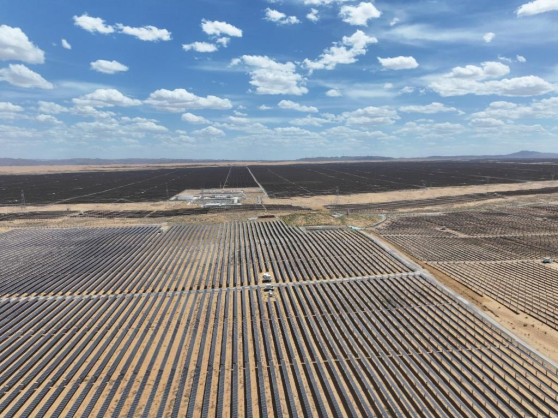
The Zhongwei 3-gigawatt photovoltaic project at the Tengger renewable energy base in Ningxia
Since the beginning of the year, CHN Energy Longyuan Power has actively seized the strategic opportunities created by the Ningxia-to-Hunan Power Transmission initiative by expanding outbound transmission channels and securing additional electricity trading volumes. Building on the 240 million kilowatt-hours of electricity already secured through July's annual and medium-to-long-term power trading, the company successfully obtained an additional 260 million kilowatt-hours through multiple rounds of supplementary monthly trading, raising its total planned outbound electricity transmission for July to 500 million kilowatt-hours. This laid a solid foundation for achieving new daily generation records.
At the same time, the company has remained focused on improving quality and efficiency by establishing an integrated operation and maintenance management system that combines routine inspections, targeted supervision and online monitoring. Supported by an intelligent centralized control platform, the project conducts around-the-clock monitoring of photovoltaic modules, inverters, box transformers and transmission lines. Routine maintenance includes cleaning inverter ventilation ducts, tightening electrical terminals, carrying out infrared thermal inspections across the entire site, and using drones to clean photovoltaic panels. The project has also refined the time-based solar tracking strategy for its single-axis tracking system to maximize solar energy conversion efficiency in the desert environment. In addition, it has continuously optimized its solar power forecasting model and established a regular coordination mechanism with the power grid operator to precisely control curtailment rates for both wind and solar power. Taking full advantage of scheduled grid maintenance periods and off-peak nighttime demand, the company has coordinated equipment defect elimination and preventive maintenance to ensure all generating units operate at full, stable capacity whenever available.

