

In the 1990s, local people used to say that the wind blew here twice a year—once for six months and then for another six months. Gullies crisscrossed the land, and the air was filled with blowing loess dust. Today, however, from the viewing platform overlooking the Heidaigou Open-Pit Coal Mine of CHN Energy Zhunneng Group, visitors see hills blanketed with pines and cypresses, rows of poplars and willows, and lush greenery stretching as far as the eye can see. Over half a century and through the efforts of successive generations, Zhunneng employees have created a green miracle on the Loess Plateau.
Greening the wasteland: commitment laid the foundation
The story dates back to the 1990s. When Wang Sanbao transferred from the Jungar Banner Desertification Control Station, he looked across the barren landscape and made a simple promise: "I will devote my life to one thing—planting and caring for trees, so future generations will inherit green mountains." Wang voluntarily took charge of quality control for tree planting and enforced standards that were almost uncompromising. He inspected every planting pit himself, requiring any pit that failed to meet specifications for size or depth to be redone.
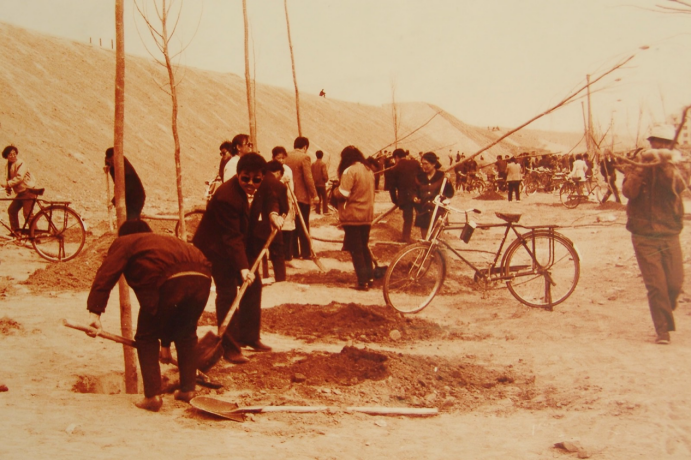
The first generation of Zhunneng's greening team planting trees
At first, some coworkers did not understand his insistence and complained that planting a tree did not require such meticulousness. Wang remained patient and explained calmly: "We're not just completing a task. We're creating cleaner air for ourselves and leaving a healthier mine and a better future for the next generation." His straightforward words won everyone over, and they approached their work with renewed dedication.
Water was scarce, with average annual precipitation of only about 200 millimeters. Whether newly planted saplings survived depended largely on experience and luck. Yet under such harsh conditions, the first generation of greening workers, driven by the belief of not claiming credit to the success of the cause, gradually transformed the mine with growing patches of green.
Nurturing green growth: craftsmanship reshaped the mine
If the mission of the first generation was to ensure the trees survived, the second generation set out to help them thrive.
When Bao Quanmin arrived in Jungar from the Hulunbuir Grassland, his first impression was that the mine's landscaping lacked diversity. By combining newly acquired knowledge with the practical experience of the previous generation, he gradually developed a new approach. Greening the mining area, he believed, should not simply mean adding vegetation; it should create landscapes in every season, with flowers blooming through three of them.
Through years of exploration and the accumulated efforts of successive generations, Zhunneng Group has gradually established a comprehensive technical system covering soil erosion control, ecological reconstruction, and land reclamation and revegetation. Plant species in the mining area have increased from just over a dozen to more than 240, with scientifically planned combinations of trees, shrubs and herbaceous plants forming a stable ecological structure. In spring, mountain apricots and forsythias bloom one after another; in summer, alfalfa and daisies flourish; in autumn, Mongolian oaks and staghorn sumacs paint the hillsides with vibrant colors; and in winter, Scots pines and Chinese pines remain evergreen, creating scenic landscapes throughout the year.
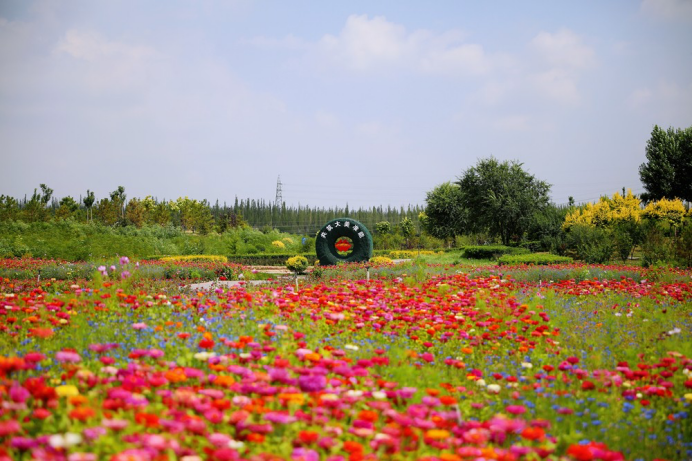
Flowers in full bloom across the mining area
To date, Zhunneng Group has reclaimed and revegetated more than 100,000 mu (6,667 hectares) of land. Vegetation coverage has risen to over 85 percent, while the soil erosion control rate has exceeded 80 percent. The mining area's microclimate has continued to improve, biodiversity has increased significantly, and the ecosystem has entered a positive cycle of natural succession.
Green industries: advancing transformation through shared efforts
Entering a new stage of development, Zhunneng employees were no longer satisfied with simply making the mining area greener and more beautiful. They began asking a more far-reaching question: Could the achievements of ecological restoration benefit both local communities and the enterprise itself, creating a path toward sustainable development?
In 2021, they pioneered an ecological development system for open-pit mines on the Loess Plateau, establishing an orchard covering more than 1,000 mu (66.7 hectares), ecological demonstration fields and solar greenhouses on reclaimed waste dumps. Land once restored solely to stabilize slopes and prevent erosion now produces tangible harvests. Apples and apricots fill the branches, while cucumbers and green beans thrive in abundance. Every year, more than 700,000 jin (350 metric tons) of fresh fruit and vegetables from the mining area are served directly in the company's staff cafeterias.
"Whenever I eat in the cafeteria and see on the table the cucumbers and corn we grew, and hear everyone say they taste great, I feel incredibly fulfilled," said Duan Guojun with a smile.
Today, more than 10,000 mu (667 hectares) of forage grass have been planted across the mining area. A 39,000-mu (2,600-hectare) orchard has been established, featuring more than 100 varieties of grapes, apples, peaches and other fruits. More than 1,000 mu (66.7 hectares) of ornamental flowers have also been planted, along with 42 solar greenhouses for fruit picking. At the same time, ecological livestock farming, leisure tourism and science education programs have continued to expand. The mining area is no longer merely a site for resource extraction but has evolved into a multifunctional green industrial complex.
From the first patches of green to vast forests, and from manual labor to intelligent transformation, successive generations of Zhunneng employees have spent half a century creating a remarkable green legacy in the great n-shaped Bend of the Yellow River.
Standing at the new starting point of its 50th anniversary, Zhunneng Group will continue to safeguard the Yellow River while advancing green, low-carbon and high-quality development, writing a new chapter in its sustainable journey.

