

From the air, a drone slowly follows its flight path, its camera scanning every photovoltaic (PV) module. On the ground, neatly arranged PV arrays quietly "soak up" the sunlight, sending green electricity thousands of kilometers away. Beneath the panels, drought-resistant plants thrive while sheep graze, bringing vibrant life to the landscape.
On June 8, the Ningxia Lingwu 4-million-kilowatt new energy base in a coal mining subsidence area in northwest China marked 100 days of operation, with power generation exceeding 1.378 billion kilowatt-hours. As one of the second batch of large-scale wind and solar power bases in China's desert areas, the Gobi and other arid areas, the base, together with the nearby Ningdong 2-million-kilowatt integrated PV base in a coal mining subsidence area, forms China's largest new energy base built on coal mining subsidence areas—the CHN Energy Ningxia Power 6-million-kilowatt integrated PV base in a coal mining subsidence area. The two sites cover a total area of 180,000 mu (12,000 hectares), equivalent to more than 16,000 football fields, and their annual power generation can meet the electricity needs of 7.2 million households for a year.

The Ningxia Lingwu 4-million-kilowatt new energy base in a coal mining subsidence area
Site selection and construction: building a PV base on subsided land
Ningdong Town in Lingwu, Ningxia, features vast stretches of uneven terrain, riddled with gullies and depressions. The landscape is consists largely of coal mining subsidence areas left behind by years of mining at several local coal mines. Traditionally, such land has been considered unsuitable for farming or construction. But see from a different angle, it has precisely the conditions needed for a PV power station: broad, open terrain, around 3,000 hours of sunshine a year, and it does not compete for land with farmland or urban areas.
"From a large-scale PV projects, it generally need to meet three key conditions. First, the landshould be flat and open, with south-facing slopes no steeper than 25 degrees. Second, annual sunshine should be at least 2,000 hours, with total annual solar radiation above 1,200 kilowatt-hours per square meter. Third, the site should be close to an existing substation or an ultra-high-voltage transmission corridor to ensure reliable power transmission and safe, stable grid operation," Luo Xiang, deputy director of the Engineering Construction Department of the New Energy Branch of CHN Energy Ningxia Power, told reporters. The site meets the project's requirements for both solar resources and grid infrastructure. The main challenge was how to build on the unstable ground left by the mining of coal.
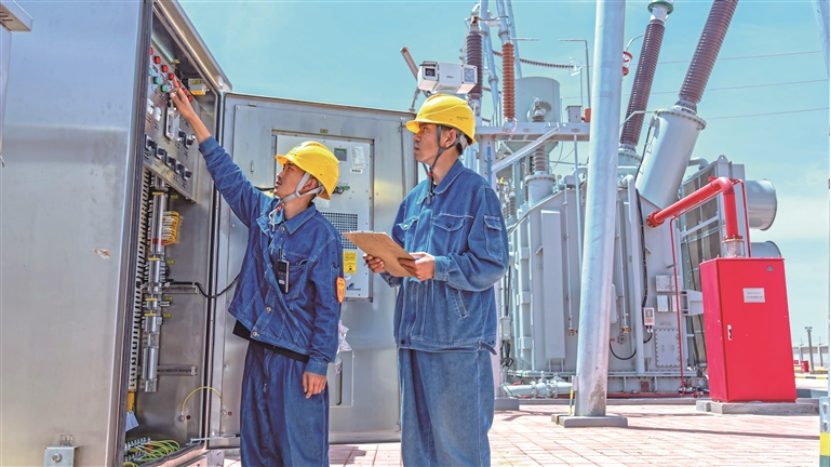
Operations and maintenance personnel conduct regular equipment inspections.
Underground mining voids can collapse unpredictably, while surface cracks and stepped subsidence can occur frequently. To ensure that the PV panels remain firmly anchored to the ground, the project team adopted different mounting solutions suited to local conditions. During the early stages of construction, the team also avoided areas prone to collapse and replaced underground cables with above-ground serpentine cable trays, substantially cutting maintenance risks.
Smart O&M: drones and robots conduct inspections
With more than 10 million PV panels spread across the site, finding faults manually is like searching for a needle in a haystack. To address this challenge, the base has introduced drone inspection systems and intelligent cleaning robots, giving the entire power station aerial "eyes" and ground-level "hands", enabling its transformation from a conventional power station into a smart energy system. The core of the system is the company's independently developed, fully domestically produced GW-scale intelligent PV management and control system—the "smart brain" of the entire power station. Previously, large-scale PV sites often struggle with complicated systems and fragmented data, with different types of equipment requiring separate management platforms.
O&M staff had to switch between multiple terminals, which was slow and inefficient. Built on domestically developed chips and operating systems, the integrated system brings power generation monitoring, equipment control, energy storage dispatch, grid response and other functions together on a single platform. From a centralized control center hundreds of kilometers away, staff can monitor equipment across the entire site on a sigle screen.
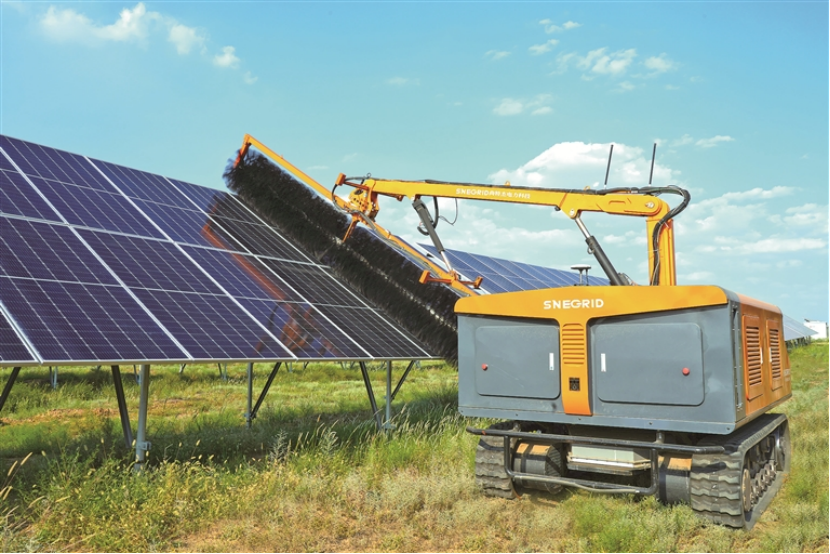
An autonomous intelligent cleaning robot cleans the PV panels.
Drones buzz overhead, robots crawl beneath the panels, and staff monitor everything from indoors—that is smart O&M in action.
Ecological restoration: power, crops, and livestock in one
Endless rows of PV panels not only generate clean electricity but also support an ecological oasis. In summer, the sophora plants beneath the panels burst into yellow bloom, while lespedeza sways with purple flower spikes, bringing vibrant life to land that was once barren.
Power generation above the panels, planting beneath them, livestock grazing between them, and restoring the soil—this is the four-in-one circular industrial chain developed at the base.
Why does grass grow so well beneath PV panels? Ningxia is dry, with little rainfall and intense evaporation. Water quickly evaporates from bare ground, leaving little chance for plants to survive. PV panels shade the ground, cooling the ground and reducing wind, slashing evaporation and creating a relatively mild microenvironment for vegetation.
Not every type of grass can be planted here. The project team faced a key challenge: the plants could not grow too tall, or they would block the PV panels and reduce power generation. At the same time, the land is saline-alkaline and dry, so the team required drought-tolerant, salt- and alkali-resistant species with well-developed root systems for sand fixation. To address this, the project team worked with the Ningxia Academy of Agriculture and Forestry Sciences to establish an 800-mu (53.3-hectare) demonstration plot, which has now expanded to 4,000 mu (266.7 hectares). Trials have included sand-stabilizing grasses such as crested wheatgrass, lespedeza and legume sophora, as well as cash crops such as Chinese bush cherry, honeysuckle and dogbane. The team is also exploring rainwater collection and drip irrigation technologies to improve plant survival rates.
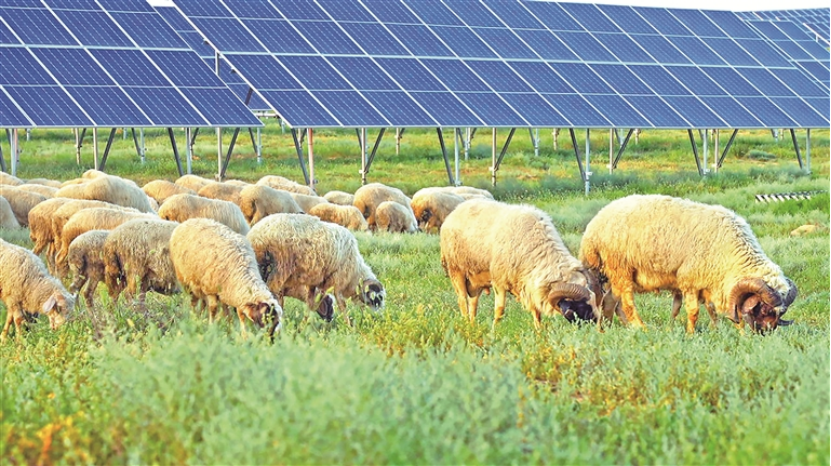
Sheep graze leisurely between the PV panels.
The thriving forage growth has naturally led to trials of livestock grazing between the panels. The first 100 sheep introduced to the site now graze leisurely between the PV arrays. The panels provide natural shade, shielding the sheep from the scorching summer sun, while nearby forage provides food, creating a small, virtuous ecological cycle. Grazing is being run as a pilot program, with local farmers brought in to manage the herds. The approach neither affects PV power generation nor leaves the available space underused.
The base has transformed a barren, scarred area into a new energy hub rich in wind and solar power, and beyond that, into an ecological haven where crop cultivation and livestock raising coexist. It offers a practical model for turning desert and Gobi lands into productive, multi-use assets. The sun powers the grid. Hope grows in the desert. This vast sea of PV panels is continuously delivering green energy to distant regions, while charting a replicable and scalable path toward energy transition and ecological restoration.

