

Along the coast of the Yellow Sea at Yangkou Port in Rudong County, east China's Jiangsu Province, the morning after a rainfall breaks with a glow of rosy clouds. Where the sea meets the land, vast rows of solar panels stretch out like waves. It is here that sunlight is transformed into electricity flowing like a current to countless homes.
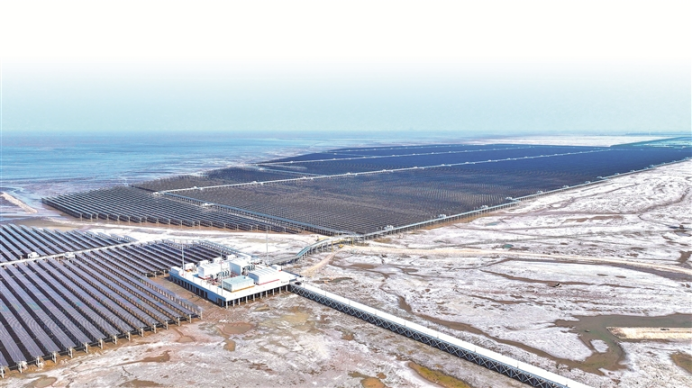
The photovoltaic array of the Rudong Integrated Solar-Hydrogen-Storage Project
The Rudong Integrated Solar-Hydrogen-Storage Project, developed by CHN Energy Guohua Energy Investment Jiangsu Company, is approaching full commercial operation. Integrating solar power generation, energy storage for grid balancing and green hydrogen production, it is the largest integrated solar-hydrogen-storage project in China. The project pioneers a new model for clean energy development in coastal intertidal zones while closely integratingrenewable energy development with coastal ecological restoration.
Making every ray of sunshine count
Outside the seawall at the Yudong Reclamation Area of Yangkou Port, the tidal flats are covered by the sea at high tide and exposed at low tide. This intertidal photovoltaic power station covers over 4,300 mu (more than 286 hectares) and has an installed capacity of 400 MW. Its pile foundations rise 7.9 meters above the ground, enabling the facility to withstand an extreme tidal surges. Nearly 700,000 bifacial solar modules capture sunlight from both sides, generating up to 400 MWh of electricity per hour during peak generation hours. Annual electricity generation is expected to reach 468 million kWh, enough to meet the yearly electricity demand of approximately 200,000 households. The project also saves about 119,000 tons of standard coal annually, equivalent to the annual carbon sequestration of roughly 1.7 million mature trees.
Conventional photovoltaic generation is highly vulnerable to daylight, weather and seasonal changes, resulting in significant fluctuations in power output. The daytime surplus electricity can exceed grid absorption capacity and lead to renewable energy curtailment, while nighttime power gap is difficult to bridge. This erratic power also risks voltage fluctuations and power imbalances within the grid. To tackle these industry-wide challenges, the project has established a complete green electricity value chain —generation, storage and conversion—that transforms the traditional single-function power plant into an integrated energy service platform.
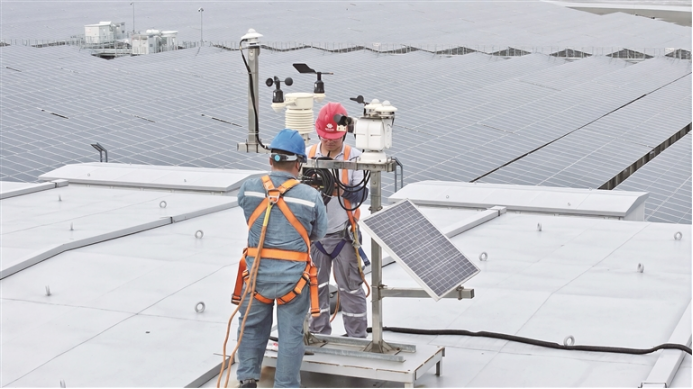
Inspection personnel calibrate the meteorological station used for photovoltaic
"In the past, our focus was simply on generating electricity and feeding it into the grid," said Jiang Bin, Project Manager of the Rudong Integrated Solar-Hydrogen-Storage Project at CHN Energy Guohua Energy Investment Jiangsu Company. "Today, as renewable energy accounts for an increasingly larger share of the power system, we must build this site into a self-regulating microgrid ecosystem that cangenerate electricity efficiently, deliver it steadily and makes good use of it—so that every ray of sunshine is put to full use."
Supporting the project is a 60 MW/120 MWh liquid-cooled battery energy storage station that functions like a giant intelligent power bank. By storing surplus electricity during periods of abundant sunshine and releasing it during peak demand, it strengthens the resilience of the new power system. When storage capacity is fully charged, excess renewable electricity is directed to a water electrolysis hydrogen production system capable of producing 1,500 standard cubic meters of hydrogen per hour. The facility is expected to produce an average of 482 tons of high-purity green hydrogen annually.
This green hydrogen can be widely used in zero-carbon sectors such as the chemical industry and transportation or converted back into electricity when needed. Through the coordinated operation of photovoltaic generation, electrochemical energy storage, and green hydrogen production, the project resolves the bottlenecks in renewable energy integration while maintaining zero-carbon emissions throughout the entire process. It also pioneers a new clean energy development model for coastal intertidal areas and marks the implementation of China's first fully integrated generation-grid-load-storage-hydrogen operating system.
Building a fully intelligent lights-out facility with technology
From above, an elevated corridor about eight meters high runs through the vast expanse of blue solar panels. This aerial walkway serves as the main operations and maintenance access acrossthe photovoltaic station.
The unique tidal environment provides ecological values but also creates major operational challenges, including salt spray corrosion, wave-induced equipment wear, and exposure to extreme weather. To overcome these difficulties, the project team has built an intelligent lights-out facility (an intelligent facility capable of lights-out operation) powered by advanced digital technologies. Inspection drones, robotic dogs, drone-based solar panel cleaning systems, comprehensive high-definition video surveillance, and offshore boundary monitoring systems work together as intelligent assistants, creating a fully integrated land-and-sea operations and maintenance network.
Once the project becomesfull operational, these intelligent systems will be interconnected to perform maintenance tasks autonomously according to predefined operating rules, without manual intervention. Compared with traditional inspections requiring two to four technicians working for nearly ten days to complete a full site survey, the intelligent system can conduct multiple comprehensive inspections in just two or three days, delivering more accurate defect detection and substantially improving maintenance efficiency.
Advancing energy development and ecological restoration together
Today, the tidal flats at Yangkou Port in Rudong present a striking viewwith vast photovoltaic arrays stretch toward the horizon, clear watersand clean shorelines, lush vegetation, and rare waterbirds such as egrets and spoon-billed sandpipers foraging and nesting in harmony. It is hard to imagine that this thriving wetland was once an ecological wasteland overrun by the invasive smooth cordgrass (Spartina alterniflora).
"To be honest, we were pretty nervous when we first took over the site," Jiang Bin recalled. "The invasive cordgrass had developed an extensive root system that aggressively displaced native benthic species and destroyed habitats for many rare migratory birds."
Removing the invasive grass became the project's first priority. After extensive scientific evaluation, the project team adopted a combination of mechanical mowing, deep ploughing, and sun drying to eradicate the vegetation, while using the shade provided by the photovoltaic panels to suppress regrowth. Eliminating this ecological invader was only the beginning. During project construction, the team also implemented a comprehensive environmental protection strategy that controls pollution at the source, reduces it during construction, and restores the ecosystemafter completion. Through careful project siting, targeted mitigation measures and systematic habitat restoration,the projectminimized environmental disturbance, and set a model where ecological conservation and economic development complement eachother.
Nature itself is the best witness. What was once a barren tidal flat has become both a vital stopover for migratory birds and a comprehensive clean energy production base. Fishermen who had given up fishing have returned.
Nowadays, renewable power generation, invasive species control and coastal wetland restoration converge to deliver ecological, economic and social benefits simultaneously. From an ecologically degraded shoreline to a thriving "blue sea" of photovoltaic arrays alive with migratory birds, this tidal flat has become one of China's leading examples of integrating coastal renewable energy development with ecological restoration.

