

A flock of swan geese spreads its wings and flies north, their high-pitched calls echoing over the winding Yellow River as their strong silhouettes dart above the waves. Every spring, these migratory birds set out from the water-rich regions of southern China, crossing mountain ranges and rivers before returning to their breeding grounds in places such as Hulunbuir in Inner Mongolia, northern China.
Dalad Banner in Ordos, Inner Mongolia, is a key stopover along the swan geese's migration route. It is also one of the key banner-level areas for the Three-North Shelterbelt Forest Program, a landmark ecological restoration project in China. Here, the flight of the swan geese and the efforts of local people come together in a remarkable way, as if two stories were being written about the same fate.

One of the shelterbelts built in Dalad Banner
Looking down from above on the Kubuqi Desert, you will discover another group of "swan geese". Wearing red volunteer vests, they too have returned year after year to sow green for survival and for tomorrow. They share a common name: the Little Swan Geese Volunteer Service Team.
In 2014, after graduating from university, Ma Chao moved from Baotou to Dalad Banner across the Yellow River, and joined Yili Power Plant of CHN Energy Guoyuan Power. The following year, he signed up for a volunteer greening activity for the first time.
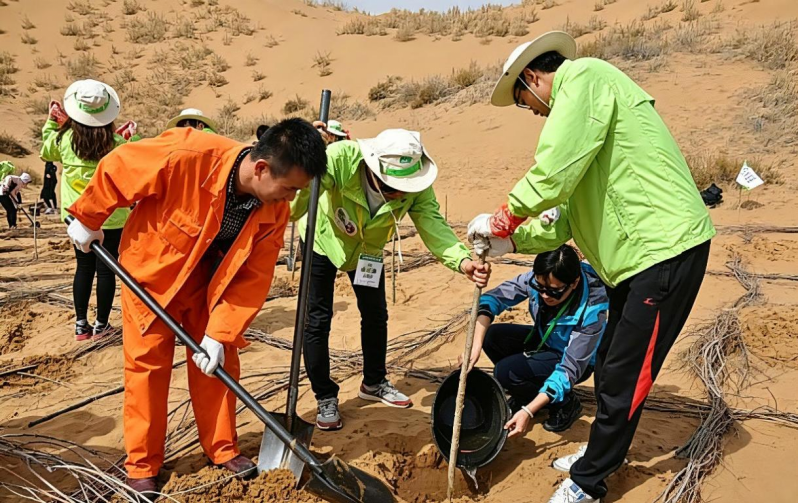
The Little Swan Geese Volunteer Service Team takes part in greening activity
That day, 20 to 30 organizations and more than 100 people gathered on the eastern edge of the Kubuqi Desert. Carrying shovels, they formed a long line and spent two or three hours digging holes, planting seedlings, covering them with soil and watering them. From 2015 to 2016, and again in 2018 and 2019, Ma Chao never missed a single activity. Someone once asked him why he kept going.
"Not everyone's home is naturally blessed with lucid waters and lush mountains. I don't want my children to grow up in the kind of environment I experienced as a child," he said.
Dalad Banner faces Baotou across the Yellow River, just 40 to 50 kilometers away. When sandstorms struck, there was nowhere to hide. As a child, Ma Chao remembers afternoons that could be bright and sunny one moment and plunged into darkness the next. No matter how tightly the windows were closed, a layer of dust would still settle on the window sills, while the air was filled with the choking smell of dust and sand.
That suffocating feeling, etched into his childhood memories, became the most persistent enemy in his heart and was transformed into his determination to bend down and plant trees.
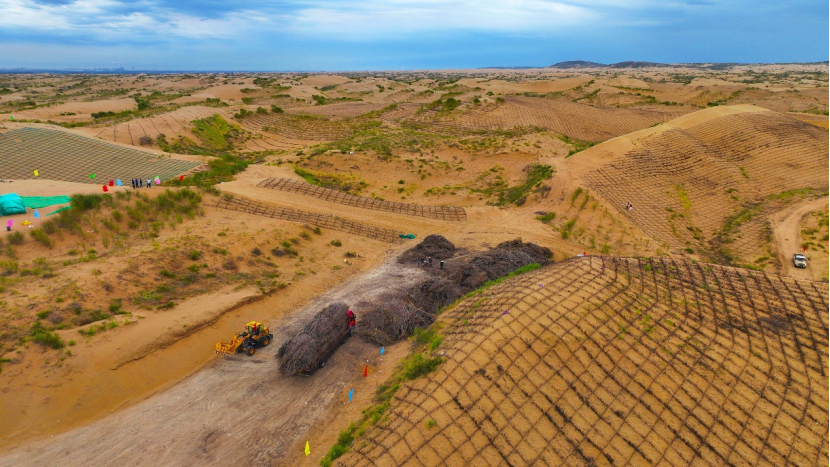
Volunteers build straw checkerboard barriers in the Kubuqi Desert
In 2020, Jin Yue, a young woman from Qinhuangdao in northeastern China's Hebei Province, also joined the Little Swan Geese team. After joining Yili Power Plant, she took part every year. One year, instead of planting trees, the volunteers built straw checkerboard barriers, using sand willow to form grids across the desert and firmly stabilize the shifting sand. In aerial photographs, the grids appear neat and orderly, with people standing among them like pieces on a chessboard.
"I had never seen straw checkerboard barriers before, so I didn't know whether they could really stop sandstorms. The local people told me they were a 'living lock' for stabilizing the sand, locking it in place," Jin Yue said.
Speaking about why she has continued to take part in tree planting and desertification control, Jin Yue said frankly, "At first, I was simply curious. But when you arrive at the site and see the vast shelterbelts planted by those who came before, the atmosphere makes you want to change your mind and become part of it."
Curiosity is the shell of a seed. Once the shell is peeled away, what remains is a heart that has taken root.
Ma Chao and Jin Yue are just two ordinary members of the Little Swan Geese Volunteer Service Team, while the team from Yili Power Plant is itself a microcosm of the volunteer movement across the entire banner. According to statistics, more than 11,000 volunteers in Dalad Banner alone have registered on the Volunteer Northern China platform, contributing more than 24,000 hours of service in total, with participation continuing to grow each year.
It is this relay of efforts year after year that has brought profound changes to the Kubuqi Desert.
The figures bear witness to the transformation. Dalad Banner has planted a total of 1.6443 million mu (109,620 hectares) of trees, while its forest coverage rate has risen from an initial 6.3 percent to 60.32 percent. The severe desertification that once plagued the Kubuqi Desert has been effectively curbed. The desert edge has retreated nearly 80 kilometers to the southeast, and the shifting sand dunes have largely disappeared. The ecological condition has undergone a historic transformation, from severe desertification to comprehensive restoration and overall improvement.
Every patch of green represents hope reclaimed from the grip of wind and sand.
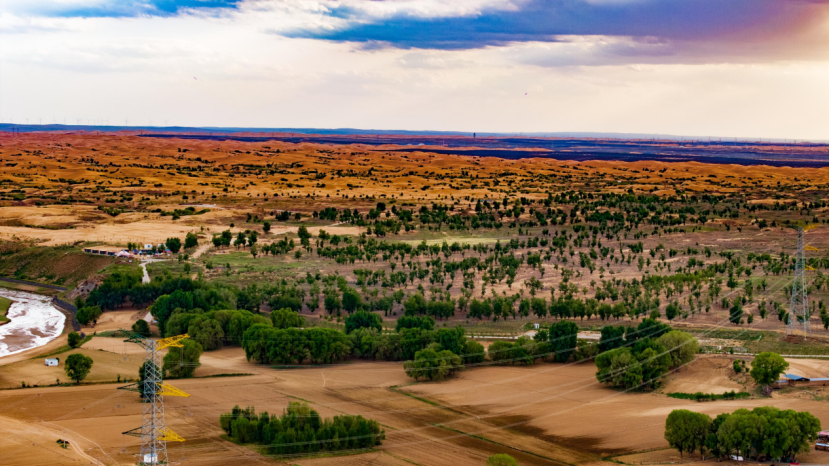
A shelterbelt built in the Kubuqi Desert in Dalad Banner
The changes are visible. Mr. Ding, a 36-year-old police officer and native of Dalad Banner, remembers that when he was a child, the worst sandstorm he experienced was so severe that daytime was basically as dark as night. Today, he has noticed a clear decline in sandstorms and an improvement in air quality. "It all started with desertification control and tree planting and greening," he said.
From the desert to the Yellow River, efforts to protect the environment have never stopped. Dalad Banner lies alongside the Yellow River, which bends here before continuing northward. If tree planting and desertification control weave green across the land, then cleaning riverbanks and protecting the river are ways of wiping the dust from the Mother River.
"People sometimes barbecue or sightsee along the river, leaving garbage behind," said Chen Hangzheng, director of the volunteer service department in Dalad Banner. "So we clean it up section by section." Before each activity, volunteers survey the site in advance, select a five- or 10-kilometer stretch of riverbank, and organize hundreds of people into groups to collect and bag the waste before it is transported away for centralized disposal.
What volunteers pick up as they bend down is not just garbage, but also a sense of reverence for the Mother River.
As the environment has improved, tourism has also flourished. The local Xiangshawan Scenic Area is renowned for its vast sea of sand, which has been deliberately preserved as a golden, singing desert amid the surrounding greenery.
A flock of swan geese flies overhead.
Beneath their wings, the vast land of northern China is undergoing a transformation from yellow to green. Green-covered dunes stand alongside dunes that remain brown and golden, watching over one another. The winding Yellow River continues to flow, its riverbanks clean.
The swan geese return north every year, stopping at Dalad Banner before continuing their journey northward. They do not know that on this land once covered by yellow sand, a group of people has been doing the same thing year after year.
For survival, for tomorrow.

