

Morning light spreads across vast stretches of forest, migratory birds skim gracefully over the river, and alfalfa sways in the breeze beneath the solar panels at Buertai, Inner Mongolia, northern China, while cattle graze leisurely nearby. It is hard to imagine that this lush, thriving land, now a place where people can live and work comfortably, was once plagued by blowing sand and dust. Through three ordinary records, we trace the vivid story of CHN Energy Shendong Coal's sustained efforts to restore ecosystems along the Yellow River Basin and tackle desertification.
A diary of green stewardship
At 6:30 a.m., with light mist still lingering among the treetops, 56-year-old forest ranger Huo Yongsheng has already slung a water bottle over his shoulder and tucked his forest patrol diary into his bag before heading into the lush greenery of the Shendong Science and Technology Demonstration Park. For 16 years, he has devoted himself to these woods, recording every change in every plant, tree, patch of land and stretch of soil in his patrol diary. Every sight and season of this forest is also deeply etched in his heart.
Huo's diary has its share of hardships. The incident he remembers most vividly, and with the greatest heartache, was a severe hailstorm in 2020. Hailstones the size of eggs suddenly came crashing down, battering rows of trees and bringing down one carefully tended pine after another. “I went to check on them that night. A huge area had fallen. I knelt beside the trees and touched them for a long time. It felt like losing a child.” Seeing the fallen trees, Huo was deeply distressed but never gave up. One thought remained firmly in his mind: he had to do everything he could to keep the trees alive.
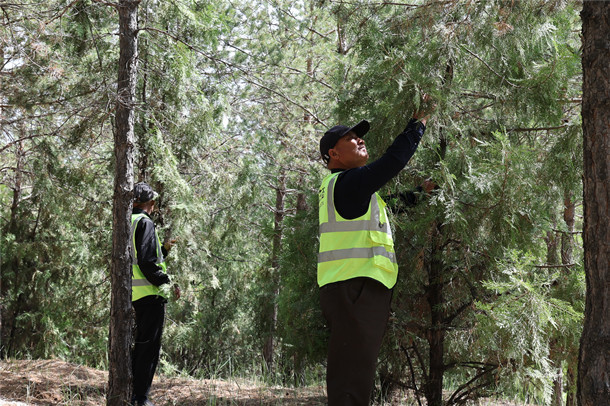
Huo and his colleagues patrol the forest.
Day after day and year after year, Huo and his colleagues have protected this green home through their quiet, steadfast efforts. Time has turned his hair gray and weathered his face, but the forest he has cared for has grown ever more lush, expansive and full of life.
A diary of check-ins
“Back at the Halagou Ecological Base for another check-in! Who would have thought that the barren slopes I knew as a child would one day become a scenic area?” Twenty-seven-year-old Jin Sheng was born and raised in the Shendong mining area. His “check-in diary” records his youth while also preserving the ecological transformation of his hometown.
“When I was a child, this place was a vast sea of sand. Spring was the hardest time of year. Sandstorms could come at any moment, and you could literally bite into sand when you opened your mouth outdoors.” In Jin's childhood memories, even “breathing came with the smell of earth and dust”. Back then, his greatest wish was to open the door and see flowers and green leaves, and to run freely in fresh air.

Jin Sheng takes photos at the Shendong Halagou Ecological Demonstration Base.
Today, Jin's “check-in diary” is filled with beautiful scenes from his hometown: the Halagou Ecological Demonstration Base is awash with flowers, with cosmos swaying in the breeze; the Wulan Mulun River glistens as flocks of migratory birds stop to rest along its banks; under rows of solar panels, green alfalfa grows alongside thriving sea buckthorn. Once determined to leave home after graduation and seek opportunities elsewhere, Jin is now filled with affection and pride for his hometown.
A notebook of growing incomes
Under the bright sun and gentle breeze, rows of solar panels stretch across 10,000 mu (about 6,667 hectares) of land at Buertai, while lush alfalfa sways beneath them.
Liu Xilin, a villager from Barituta Village, flicks his herding whip as more than 100 beef cattle behind him lower their heads to graze on fresh pasture. A smile spreads across his face as he says with satisfaction, “The vegetation here used to be sparse, and the cattle could never get enough to eat. Since we started planting alfalfa beneath the solar panels, raising cattle has become much easier.”

Liu Xilin and his wife tend cattle beneath solar panels.
As someone who has raised cattle around the mining area for most of his life, Liu has witnessed the transformation of this land firsthand. In the past, vegetation was sparse and bare sand was exposed. Even after roaming all day, the cattle could not get enough to eat, so he had to purchase large quantities of corn stalks as supplemental feed, driving up costs while keeping returns low.
With the construction of CHN Energy Shendong Coal's Buertai Practice and Innovation Base and the development of an integrated solar power + ecology + industry model, large areas beneath the solar panels have been planted with high-quality forage crops such as alfalfa, protein-rich feed mulberry and sea buckthorn. With their extensive root systems and strong vitality, these plants help stabilize sand, conserve soil and restore the ecosystem. Their high nutritional value and yields have also made them a valuable source of additional income for local villagers.
Liu was among the first to benefit. Today, he brings his cattle beneath the solar panels, where they graze freely on alfalfa and grow strong and healthy. During the harvest season, he can also bale the alfalfa and store it as feed for the off-season.
“Alfalfa can be harvested two or three times a year. Each time, I can haul several truckloads, with each truck carrying 8,000 to 9,000 jin (4,000 to 4,500 kg). Just on buying forage, I save a substantial amount of money.” The cattle farmer who once worried about having enough feed now speaks with confidence. The crisp crack of the herding whip and the lively cattle echo across the land. The regenerated oasis beneath the solar panels not only holds back the wind and sand, but also helps nourish the livelihoods of local people.
Time speaks quietly, while hard work leaves its mark. CHN Energy Shendong Coal has shouldered its responsibility for ecological conservation and high-quality development in the Yellow River Basin, upholding the principles of ecological priority and green development. It has coordinated efforts in desertification control, sandy-land improvement, vegetation cultivation and ecological restoration in subsidence areas, continuously strengthening the ecological foundation for sustainable development in the mining area. Today, vegetation coverage in the Shendong mining area has increased from 3 percent to 11 percent to more than 64 percent, and the young saplings of the past have grown into flourishing forests.
Three records, three perspectives, tell one shared story: through perseverance and dedication, Shendong has transformed barren deserts into lush forests, ensuring that ecological restoration delivers not only greater beauty but also greater value. It has also helped keep the land green and vibrant while bringing greater well-being to the people who call it home.

