

On October 1, as people across China celebrated the National Day holiday, a different scene unfolded at Anqing Power Plant, operated by CHN Energy Anhui Branch in eastern China. Along the north bank of the Yangtze River, coal carriers sounded their horns as they docked, while grab buckets on ship unloaders swung back and forth. At the plant, steel rebar supports stood in rows at the construction site of Phase III, a project comprising two 1,000-megawatt generating units, as bright welding sparks flashed one after another. Inside the control room, figures changed in real time on a smart monitoring screen. The number 2,579 represented the live construction workforce on site at 11 a.m. With the project entering a critical stage, all construction sections are working to a tight schedule, aiming to bring Unit 5 online by the end of the year and Unit 6 before the Spring Festival, making the most of the prime construction season.

Anqing Power Plant Phase III project
The city of Anqing has long been defined by a spirit of hard work and determination. More than a century ago, Zeng Guofan established the Anqing Ordnance Workshop here, where China's first steam engine and first powered vessel were built. More than a century later, on the banks of the same river, CHN Energy's Anqing Power Plant is embarking on what amounts to a “third venture”. Since its first phase, comprising two 320-MW units, came online in 2005, followed by the completion of two 1,000-MW units in Phase II in 2015, the plant has spent more than two decades on the banks of the Yangtze, serving as a major energy hub in southwestern Anhui Province.
The current Phase III project will add two 1,000-MW units designed to deliver reliable power while responding flexibly to changes in demand. Featuring ultra-supercritical technology with double reheat, the units are designed to meet next-generation standards for coal-fired power generation, with improvements in both coal consumption per kilowatt-hour supplied to the grid and peak-load regulation capabilities. Once completed, the plant's total installed capacity will reach 6.66 million kilowatts, placing it among China's leading power plants, with annual electricity generation expected to reach approximately 25 billion kilowatt-hours.
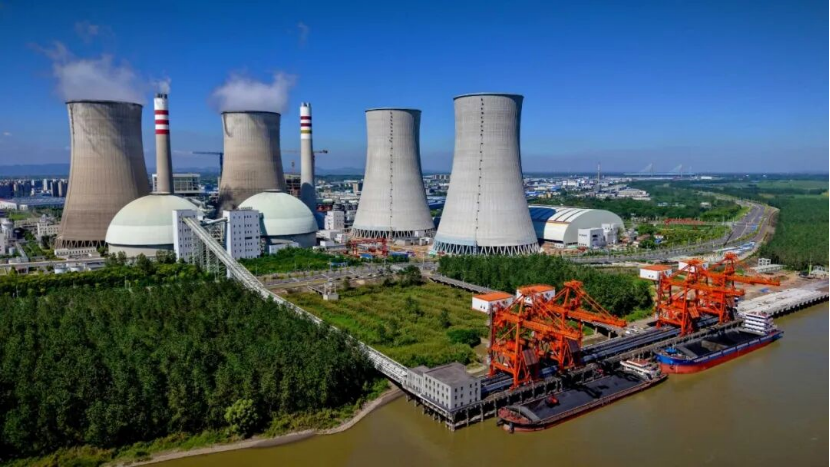
Anqing Power Plant on the banks of the Yangtze River
For those building Phase III, this year's National Day holiday has been anything but quiet. “Our days generally run from 7 a.m. to 9 p.m., and when deadlines are tight, we sometimes work through the night,” said Ding Sheng of Anqing Power Plant's Production Preparation Office. The project has entered its final sprint. To ensure the generating units can be successfully connected to the grid, more than 40 members of his department remain on site every day, moving between nearly 30 locations to test systems, commission equipment and handle unexpected problems.
“Except for lunch, we spend almost all our time on site. On the busiest day, I walked more than 30,000 steps,” he said.
As Ding spoke with reporters at the construction site, several workers were jointly lifting a steel pipe onto a support frame. Short commands crackled over their walkie-talkies: “Lift—stop—good.” Nearby, a worker was welding on a tower structure, sending sparks cascading from above like fireworks on National Day.

Ding Sheng monitors the operating status of a closed-loop water pump.
Commissioning and production preparation are just some of the many tasks that must be completed before a generating unit is connected to the grid. At a construction site for million-kilowatt-scale units, multiple trades work simultaneously, with thousands of people entering and leaving the site each day. Ensuring construction safety is therefore a top priority. Anqing Power Plant has developed its own distinctive approach to this challenge.
Inside the smart construction monitoring center, a large screen on the wall alternates between live data updates and split-screen views of the construction site. Two staff members move their computer mice, bringing workers located more than 100 meters away into sharp focus, even though they appear no larger than a thumb to the naked eye. The smart construction site system was planned and deployed proactively before Phase III construction began. Its 160 high-definition cameras cover the site and automatically identify risky behaviors, such as failing to wear a safety helmet properly or failing to secure a safety harness correctly. Alerts are issued immediately to help minimize potential safety hazards.
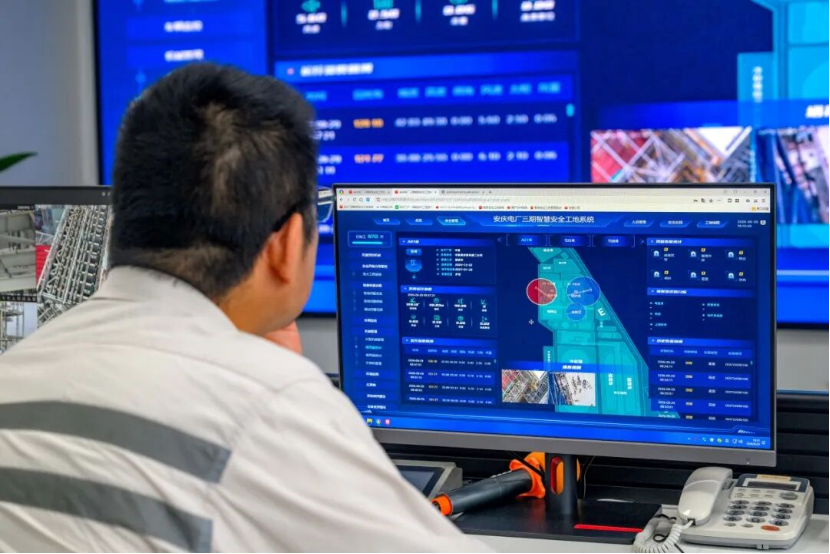
The smart construction monitoring center for Anqing Power Plant Phase III
“In the past, we relied on people watching people and running around the site. Now, the data comes straight to us. Look, this is the latest update from the system: 2,579 people are working on site today. Their distribution across construction sections, occupational categories and entry and exit times are all clearly displayed,” said Wang Lin, deputy director of the Safety, Health and Environmental Protection Department, with evident pride. Having participated in the system's design from the outset, he knows its capabilities inside out.
Guided by the principles of practicality, usability and effectiveness, the system goes beyond intelligent identification of risky behaviors. It also provides closed-loop management of site access, covering everything from safety training to entry control. Anyone who has not completed the required safety training is prohibited from entering the site. Machinery and equipment are managed through a one-machine-one-code system, while tower crane operations are monitored in real time to provide early warnings of overloading, tilting and collision risks. Anqing Power Plant has implemented numerous other smart management measures as well. As of October 1, Phase III had been under construction for 674 days without a single safety incident. The plant is now striving to make the project a recipient of the National Quality Engineering Gold Award, one of China's top honors for engineering quality.
Just over 10 kilometers west of the power plant stands Zhenfeng Pagoda, a well-known local landmark. Residents of Anqing have a saying: “Once you pass Anqing, there are no more pagodas worth mentioning.” Standing by the river for more than 400 years, the pagoda has watched countless vessels come and go. Anqing Power Plant, which has likewise remained on the riverbank for more than two decades, is now accelerating its transformation, safeguarding the lives of riverside communities with abundant and reliable electricity.
Throughout the National Day holiday, the Yangtze continued flowing eastward, and construction carried on as usual. In just a few months, Unit 5 of Anqing Power Plant's Phase III project is expected to be connected to the grid. The days spent rushing between tasks at the construction site will eventually be reduced to lines of text on a project progress chart. But the river will remember, and the city will remember, that during this National Day holiday, a group of people stayed at their posts here, working hard and striving toward their goal.

