

Deep in the Yunnan-Guizhou Plateau in southwestern China, towering mountains rise beneath intense sunlight. Along a ridge at an altitude of 2,800 meters, rows of deep-blue photovoltaic panels follow the contours of the mountains, gleaming in the sun. This is the Yaolingshan Solar Farm, operated by CHN Energy Guohua Energy Investment's Guangxi (Guizhou and Yunnan) Branch. Construction began on June 1, 2024, and the facility was connected to the grid on December 21 of the same year. With a total installed capacity of 140 megawatts, it has generated a cumulative 311 million kilowatt-hours of electricity to date.
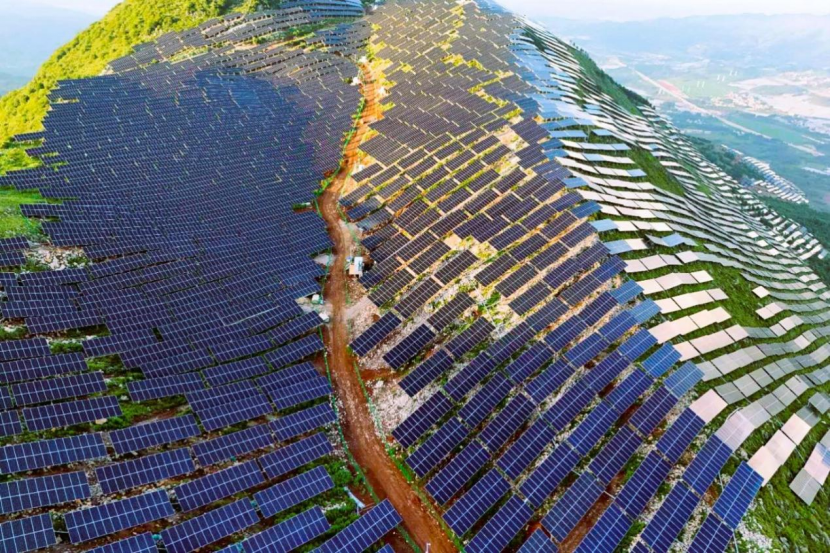
Panoramic view of the Yaolingshan Solar Farm
The rugged terrain and steep slopes of Yaolingshan posed major challenges to solar farm construction. With the construction site perched atop a mountain, heavy equipment could not reach it directly, making the transportation of construction materials the biggest obstacle.
“The early stages of construction were extremely challenging. We had no choice but to rely on both manual labor and drones and push through,” said Wang Wenxue, head of the Yaolingshan Solar Farm. At the time, four drones each operated for an average of five hours a day, making up to 200 flights daily. Heavy equipment was lifted by drone, while smaller components were carried on workers' backs. During construction, workers made several trips up and down the mountain each day, and their uniforms were never dry. Zhao Wei, who was responsible for production preparations, walked an average of 15 kilometers daily and spent four consecutive months stationed in the remote mountains, from the start of construction through grid connection.

Construction site of the Yaolingshan solar project
One panel at a time, the array took shape, transforming the once-barren mountainside.
Completing the solar farm was only the first step. The greater challenge was keeping it running. The site covers a vast area, with solar arrays spread across the terrain, while the operations and maintenance team is small. Daily inspections are therefore non-negotiable. In summer, the surface temperature of the panels can approach 55°C. Carrying thermal imaging cameras, maintenance staff scan the rows of panels and inspect every connector to ensure nothing is overlooked. Meanwhile, data streams continuously into the control room around the clock. Any abnormal current in a branch circuit or equipment temperature exceeding safe limits requires an immediate response. On-duty staff keep their eyes fixed on the screens, never letting their guard down.
Zhao Wei has worked on shift duty for 14 years. During one shift, he detected abnormal data from an inverter and a communications failure. He promptly reported the problem, arranged for the equipment to be shut down, and dispatched personnel to inspect the site. They quickly extinguished a fire that had broken out in the inverter, effectively preventing the flames from spreading across the solar farm and averting further equipment damage. “Nothing here is earth-shattering. We just have to do our everyday jobs well. If the electricity we deliver is steady and the grid remains safe, then we've done our job properly,” he said.
Yet no matter how routine and meticulous daily maintenance may be, nothing is more nerve-racking than an emergency repair. During a storm accompanied by strong winds and lightning, the farm's outgoing transmission line was struck by lightning, causing the conductor on phase B to partially break. After the damage was discovered during an inspection, Wang Wenxue promptly contacted the grid dispatcher to arrange a power outage and led a team to the site for repairs. The terrain was treacherous, and the work took place at night, with severely limited lighting. Some equipment had to be switched off, and the team worked in near darkness. By flashlight, they reconnected the broken wire ends one by one, tightened each screw, and checked every joint. “By the time we finished, dawn was almost breaking,” Wang recalled calmly, though his words conveyed little of the hardship the team had endured that night.

Solar array in Block 35 of the Yaolingshan Solar Farm
Beyond routine maintenance and emergency repairs, the solar farm must also ensure a stable power supply. It is equipped with an energy storage system rated at 14 MW/28 MWh, which was completed and commissioned on June 28, 2025. Even after sunset, when there is no sunlight, the system can provide two hours of stable support to the grid, helping ensure a reliable electricity supply at night.
The installation of solar panels has not only improved the stability of the power supply but also allowed the mountain ecosystem to recover gradually. Green grass grows freely beneath the panels, helping preserve the existing local ecosystem. However, excessive grass growth can create a fire hazard. To address this risk, the solar farm hires villagers from nearby communities to cut and clear the grass whenever it grows taller than two meters. According to statistics, the farm organizes two rounds of grass cutting and maintenance across the entire site each year. Each round takes 40 days, employing an average of 20 local workers per day. Each worker can earn more than 20,000 yuan (approximately 2,800 USD) in additional annual income. This convenient source of employment close to home is warmly welcomed by local villagers.

Green grass growing beneath the solar panels
Grass cutting helps prevent fires, but the farm's fire prevention efforts extend well beyond that. To strictly implement forest fire prevention requirements, the farm equips the solar panel areas with fire extinguishers, fire swatters, and other equipment to meet its own fire safety needs and shorten response times to fires in surrounding areas. It also conducts regular public awareness campaigns to educate villagers about fire prevention and electrical safety.
On July 14, 2025, exciting news echoed across the plateau: the solar farm's cumulative power generation had surpassed 100 million kilowatt-hours! This 100 million kilowatt-hours of clean electricity could light the homes of millions of families, power the humming machinery of factories, and reduce carbon dioxide emissions by tens of thousands of tons. It was the highest recognition of the team's hard work and dedication.
Sunlight comes from the mountains, and electricity flows to homes across the land. At Yaolingshan in Yunnan, green energy has given the once-barren mountains a new purpose. In the past, the only traces of human activity here were hoofprints left by horses. Today, solar panels stretch along the ridgelines, turning sunlight into electricity. Once, people crossed these mountains in the hope of bringing life to this quiet land. Today, others remain stationed in these remote hills to keep homes illuminated across the region.
The mountains remain the same, and the roads have not changed. But the people who travel them continue to work toward the same goal: making life brighter for ordinary people, day by day.

