

In early autumn, at Baizhuping Village, Badu Town, Jishui County, Ji'an, Jiangxi Province in southeastern China, the sky stretches wide and high, and a hint of coolness lingers in the breeze. Looking across the rolling hills, rows of blue solar panels shimmer in the sunlight, resembling waves spreading across the landscape. Beneath them, Turpinia arguta, a valuable medicinal herb prized for its leaves, is thriving and entering its harvest season. Villagers bend down and move between the plants, picking leaves and filling baskets. Their laughter can often be heard drifting across the fields.
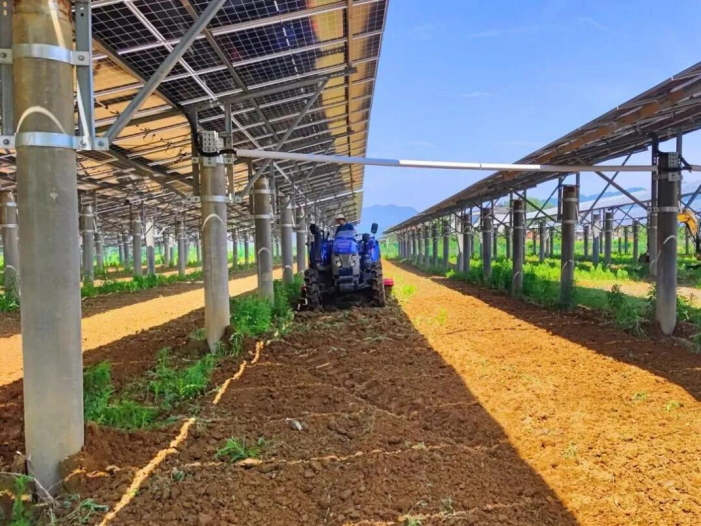
The Jishui Badu agrivoltaic project
Just a few years ago, however, this land looked entirely different. "Nothing would grow on these slopes. We worked hard all year but earned less than 1,000 yuan (approximately 140 USD) per mu (0.067 hectares). Young people all left to find work elsewhere, and the land was left abandoned. It was heartbreaking to see," said an elderly villager surnamed Liu, in his sixties, as he squatted by the field.
A turning point came in early spring 2023, when the Jishui Badu agrivoltaic project, developed by Wanan Power Plant of CHN Energy Jiangxi Branch, brought new hope to Baizhuping Village.
When the project team first arrived, the area was covered with waist-high, withered weeds, making even walking through the land difficult. Faced with villagers' concerns, team members patiently visited households one by one to explain the project. They also invited village representatives to visit an established demonstration site elsewhere in Jiangxi Province. There, they saw for themselves that agricultural machinery could operate as usual beneath elevated solar panels, while Turpinia arguta grew lush and healthy. It turned out that moderate shading reduced soil moisture evaporation, allowing the medicinal plants to retain more moisture and grow more vigorously.
Seeing was believing, and the villagers' concerns were finally put to rest, allowing the project to move forward smoothly. During the planning and design process, the team carefully balanced the needs of farming and power generation. The lowest point of the solar panels was raised 2.6 meters above the ground, while the spacing between rows was widened to 6.5 meters. This allowed small tillers and weeders to move freely underneath the panels. Evenly spaced gaps between the panels also allowed rainwater to seep naturally into the soil, ensuring more uniform irrigation. In addition, the team installed an extra layer of shading netting, which not only improved the power generation efficiency of the bifacial solar panels but also created a mild, humid growing environment suitable for the shade-loving Turpinia arguta.
Today, the medicinal herb cultivation base, covering more than 1,000 mu (approximately 66.7 hectares), is equipped with an integrated water and fertilizer management system, and its planned planting area of 410 mu (approximately 27.3 hectares) has been completed. Turpinia arguta is a valuable medicinal plant whose leaves are used in traditional medicine for their heat-clearing, detoxifying, throat-soothing and swelling-reducing properties. Once planted, it can be harvested continuously for more than 15 years. At peak production, the annual output value can reach as much as 9,000 yuan (approximately 1,260 USD) per mu (0.067 hectares). The base has also established links with pharmaceutical companies in advance, ensuring a reliable market for farmers' produce.
As medicinal herb cultivation continues to expand, the solar power project achieved full-capacity operation in August 2024. It can generate an average of 110 million kilowatt-hours of electricity annually, saving approximately 31,000 tons of standard coal and reducing carbon dioxide emissions by more than 80,000 tons each year. Clean energy is now being continuously delivered to households across the region. Beyond creating favorable conditions for Turpinia argutacultivation, the project has also diversified local employment opportunities, helping 80 rural households increase their annual income, with each household earning an additional 5,000 yuan (approximately 700 USD) on average.
From barren hillsides to productive farmland, the blue solar panels above generate electricity to light homes, while the golden leaves below put more money into villagers' pockets. This successful example of agrivoltaics is helping shape a new vision for rural revitalization, bringing together ecological improvement, more efficient industries and rising rural incomes.

