

October in Ulanqab, a city in north-central China's Inner Mongolia Autonomous Region, brings swaying reeds and flocks of waterbirds at Lake Huangqi. At Lake Dai in Liangcheng County, also in Inner Mongolia, just dozens of kilometers away, the cooling towers of a power plant stand quietly by the lakeshore. The two lakes face each other, with railway tracks running between them.
The Xinshuo Railway is a major artery for transporting coal out of western Inner Mongolia and a key pillar of CHN Energy's integrated operations. Every year, hundreds of millions of tons of coal travel across Shanxi and Inner Mongolia via the Dazhun, Zhunchi and Bazhun lines, joining the Daqin and Shuohuang railways before heading to northern ports and power plants along the routes.
For decades, this railway has delivered light and warmth to communities far and wide. Today, it is also bringing green development to every stretch of land along its routes. Balancing energy supply with the green transition, this heavy-haul railway, primarily dedicated to coal transportation, is creating a new picture of sustainable development across China's beautiful northern frontier.
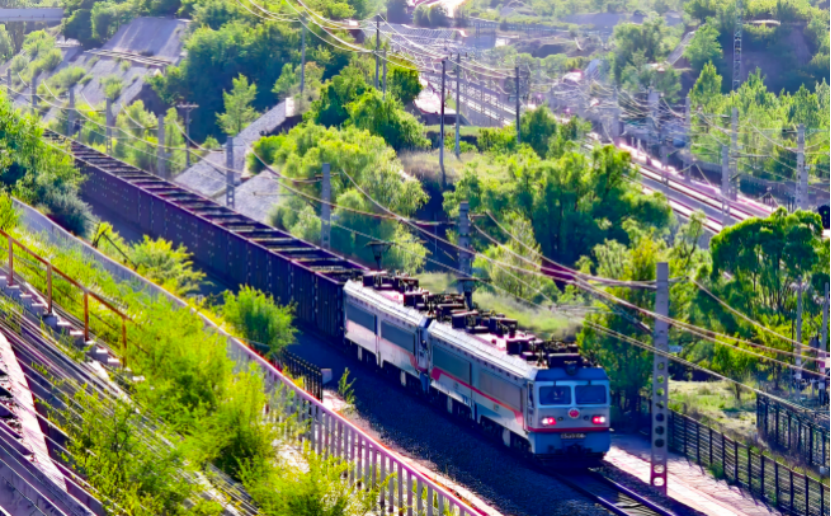
A 10,000-ton coal train serving energy supply needs runs through lush greenery.
The green transition begins with cleaner traction power. Xinshuo Railway has taken the lead in exploring the hydrogen energy industry chain and jointly developed China's first domestically developed high-power hydrogen-powered locomotive for heavy-haul railways, ushering in a new era of clean energy propulsion. The country's first 2,400-kilowatt high-power hydrogen-powered shunting locomotive has completed a trial involving the loading and transport of 10,000 tons of coal. Powered by hydrogen, it pulled 105 C80 freight wagons at a constant speed over a distance of two kilometers, consuming 40 kilograms of hydrogen fuel. This marks a major breakthrough in the commercialization of high-power hydrogen-powered equipment for China's heavy-haul railways.
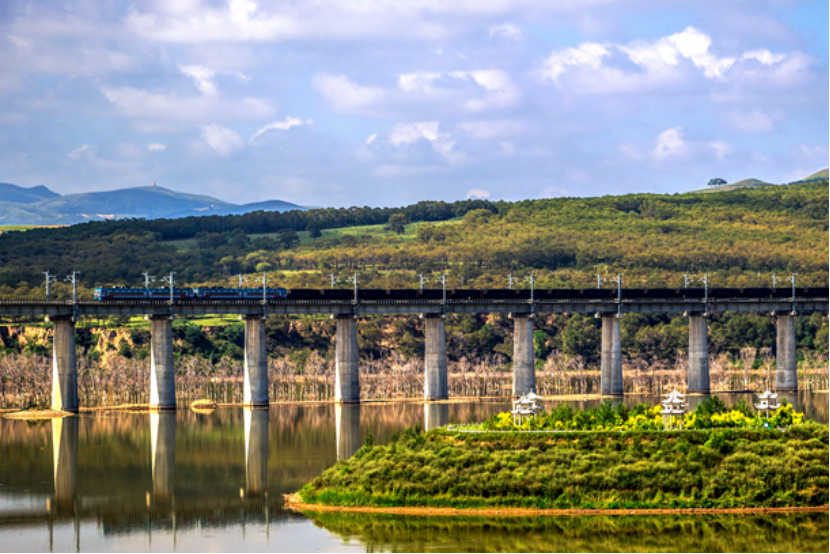
A 10,000-ton train travels through lush mountains and lucid waters.
Meanwhile, the country's first heavy-haul electric-electric dual-power locomotive has begun trial operations at Nanping Station. A demonstration project integrating the power grid, energy sources, energy storage and trains is also underway, expected to reduce annual emissions by approximately 5,500 tons. Xinshuo Railway has taken the lead within CHN Energy in achieving 100% consumption of green electricity. Clean energy is gradually replacing conventional energy sources for hauling 10,000-ton trains, station lighting and heating. From hydrogen-powered and dual-power locomotives to green electricity supply and the application of new equipment, the railway is replacing conventional energy with clean alternatives, extending its green transition from individual breakthroughs across the entire operational chain.
Beyond changes in traction power, Xinshuo Railway has also integrated ecological protection into every stage of its transportation operations. It carefully safeguards the environment along its routes, with more than 300 mu (approximately 20 hectares) of green corridors stretching across the landscape and 68,000 square meters of greenery planted around railway stations. Garden-like stations and zero-carbon station areas are scattered along the routes, allowing this steel giant to continue running through a picturesque landscape.
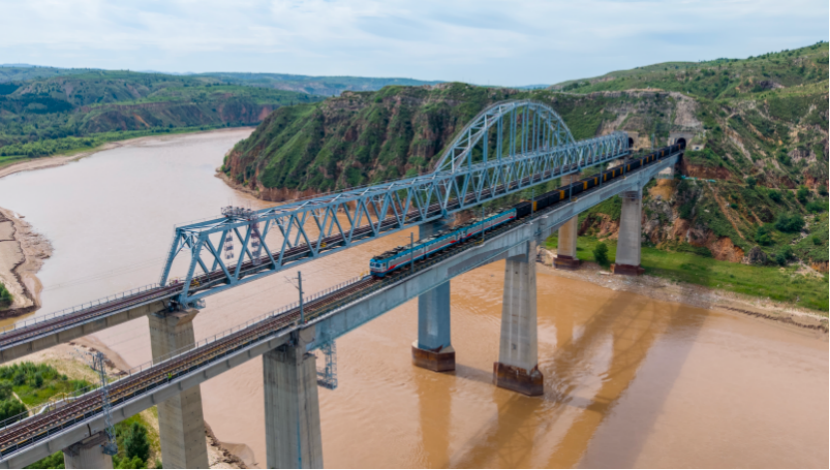
A 10,000-ton train crosses the Yellow River.
With bluer skies, cleaner water and more peaceful communities, Xinshuo Railway has adopted tailored measures to address local conditions, exercising strict control over noise, dust, pollution and waste throughout its operations. More than 80 coal-fired boilers across the railway network have been upgraded, reducing annual carbon dioxide emissions by approximately 35,000 tons. Noise barriers have been installed in more than 40 villages along the routes to protect the peace and quiet of local communities. Fully enclosed coal storage facilities and intelligent dust-suppression systems have been deployed across the network to reduce coal dust pollution at source.
At the same time, Xinshuo Railway is actively exploring new approaches to solid waste management and contributing to CHN Energy's efforts to build a waste-free enterprise. Construction waste along the railway routes is stored in compliance with regulations, while hazardous waste is subject to digital management throughout its entire lifecycle, from generation and storage to transfer and disposal, maintaining a 100% compliant disposal rate. The disposal of idle and obsolete materials has also helped unlock the value of existing assets, with auction proceeds exceeding 100 million yuan (approximately 15 million USD), allowing resources to deliver greater value through recycling and reuse.
Migratory birds skim across the lakes, traveling with the seasons, while steel rails cut through the wilderness, carrying coal to destinations near and far. As steel arteries embrace lush mountains and lucid waters, and industrial civilization blends with ecological civilization, the weight of a heavy-haul railway represents not only its responsibility to ensure energy supply, but also its commitment to protecting the environment. Firmly committed to its green transition, Xinshuo Railway is demonstrating through concrete action how high-quality development can be achieved, injecting fresh vitality and powerful momentum into the vision of a Beautiful China.

